

Increased use of renewable energy sources in future will require large storage capacities. As resources are scarce, alternatives to lithium-ion technology are studied. Within the framework of the “BiFlow” project, Karlsruhe Institute of Technology (KIT) and partners now develop a novel hybrid storage system that combines specific advantages of the lithium-ion battery with those of the redox-flow battery and can also be used to store heat. The project is funded with EUR 1.3 million by the Federal Ministry for Economic Affairs and Energy (BMWi).
So far, home storage systems for storing power from renewable energy sources have been mainly equipped with lithium-ion batteries. Li-ion batteries are compact and comparably inexpensive. In this respect, the less widely used redox-flow technology is at a disadvantage. The latter’s advantages, however, make operation attractive in certain cases. “Power and energy of redox-flow batteries can be scaled as desired. In addition, they have a long service life, good cycle stability, and high operational safety,” says Nina Munzke from KIT’s Battery Technology Center, manager of the BiFlow project. “We now plan to combine these two types of batteries and their advantages and to compensate their drawbacks. In addition, we want to use the electrolyte tanks of the redox-flow battery to store heat, thus increasing total efficiency of the system. This type of cogeneration is the first of its kind in the world.”
Data for the Energy Transition: Test at the Students Residence
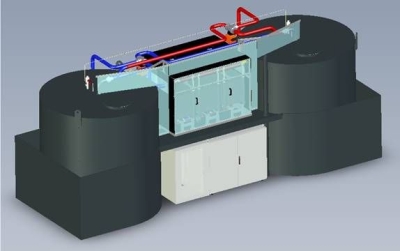
to store heatfor the first time. (Graphics: Storion Energy GmbH)
For the project, project partner Storion Energy GmbH (SEG) will install a redox-flow battery in the STAGE76 students residence in Bruchsal. Thanks to a special stack design by Storion (the energy converter of this battery type) high power densities.are achieved. KIT will be responsible for overall system integration and smart control of the entire storage system. The third project partner, Fraunhofer Institute for Chemical Technology (ICT), will develop an optimized electrolyte composition for the redox-flow battery, which will be needed for thermal use. The electrolyte used in the battery will not be recycled, but simply reused, evenafter about 20 years when the life of the battery system ends.
In general, the storage system will increase the building’s independence of the power grid. Surpluses of solar power, which exceed the electric capacity of the hybrid storage system, will be used for the building’s heat supply, as will heat losses during charge and discharge of the redox-flow battery. Wide use of measurement instruments will enable in-depth analysis and visualization of system operation. “We are very happy about the installation of this research facility,” says Matthias Holoch, operator of the students residence. “It will not only provide important data for the energy transition, but supply our students with power and heat.”
Smart Energy Management of a Complex System
In addition, the hybrid storage system will provide a charging system for electric cars with three charging stations of 22 kW each. These charging stations will also be included in the self-consumption optimization scheme and controlled optimally based on the user behavior. “Our goal is an overall system of maximum economic efficiency. For this purpose, we do not only develop an optimized storage management system, but also an overarching smart energy management system. For sector coupling, BiFlow will combine power supply with heat supply and mobility in a system of high complexity,” says Dr. Christian Kupper from the Battery Technology Center, who is also involved in the project.
More about the KIT Energy Center: http://www.energy.kit.edu