
Professional world in the knowledge and information society is increasingly influenced by digital media. The research project “Artistic-technical Media Education in the Preparation for a Job: New Approaches to Promoting Digital Media Competence of Adolescents”, briefly called MediaArt@Edu, is aimed at familiarizing young people with modern media technology after leaving school and before starting a profession. The Federal Ministry of Education and Research funds the research project at Karlsruhe Institute of Technology (KIT) with EUR 360,000 for a period of three years.
The project executed by the Institute of Vocational Education and Training and General Pedagogics (IBP) focuses on young women and men participating in training preparing them for the job. “In most cases, young people consume digital media passively only. We make them actively design media technology,” says project head Dr. Daniela Reimann. At KIT and at the cooperation partner, the Center for Art and Media Karlsruhe (ZKM), the young people work on digital media design, from virtual 3D worlds to interactive robots and light objects with LED toolkits.
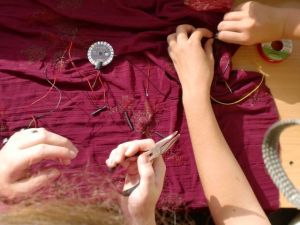
In addition, the participants work on “smart textiles” at KIT. These are pieces of clothing, into which electronic components are inserted, connected, and programmed. “The young people learn how they can influence, design, and construct these supposedly magical devices,” explains Reimann. The concept that combines esthetic education with media and vocational pedagogics is intended to enhance technical understanding and interest. The young people are participants in pre-job training courses offered by the Karlsruhe Employment Agency and the protestant youth welfare service Hardtstiftung e.V. and pupils who try to find out what profession would be suitable for them.
Reimann, educator in the field of art and media technology, emphasizes that less privileged young people also have to be given access to a technical vocational training in order to meet the growing need for qualified experts in the engineering sector. The project is also aimed at getting girls and young women into technical professions. Students of IBP/KIT act as mentors and support the young people in the use of media and observe their development with respect to a future job. It is planned to extract modules for the future training of teachers from the project. “The young people are supported in visually documenting and reflecting own learning and work processes based on a portfolio concept. As a result, competences and capabilities are visualized,” says Reimann.
The research project is part of the BMBF program for “strengthening digital media competence for future media education in professional qualification” and scheduled for a duration until August 2015. Apart from the ZKM, Siemens AG Karlsruhe and the regional BEO Network for Professional Orientation are partners of the IBP/KIT project.
In close partnership with society, KIT develops solutions for urgent challenges – from climate change, energy transition and sustainable use of natural resources to artificial intelligence, sovereignty and an aging population. As The University in the Helmholtz Association, KIT unites scientific excellence from insight to application-driven research under one roof – and is thus in a unique position to drive this transformation. As a University of Excellence, KIT offers its more than 10,000 employees and 22,800 students outstanding opportunities to shape a sustainable and resilient future. KIT – Science for Impact.