
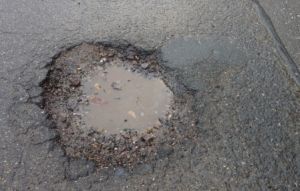
Every winter, they are in the focus of the public: Potholes and other road damage. Municipal roads are particularly affected. Often, money for systematic maintenance is lacking. In addition, quality of construction and maintenance is insufficient. These topics will be covered by the colloquium “Preventing Municipal Road Damage” on Wednesday, November 23, 13.30 to 16.45 hrs at the Altes Bauingenieurgebäude (building 10.81), room 93, on KIT Campus South. Journalists are cordially invited.
The colloquium is organized by the Institute of Highway and Railroad Engineering (ISE) of KIT under the direction of Professor Ralf Roos. Among others, ISE scientists study causes and mechanisms of road damage, quality assurance measures for a long use of asphalt roads, and repair strategies for potholes. They will present their results at the colloquium. However, the colloquium will not only cover scientific aspects, but also asphalt technology, planning, and policy. Construction experts report about the management of road conservation in the city of Karlsruhe and short-term and permanent repair of winter damage.
The colloquium addresses staff of administrations, engineering offices, and industry, scientists as well as students.
More information and program: http://www.ise.kit.edu/
In the journalist portal “KIT-Experten“:
http://www.pkm.kit.edu/kit_experten_3881.php, Professor Ralf Roos and Dr. Carsten Karcher explain why potholes are not just a winter problem and what municipalities can do to prevent them in the long term.
In close partnership with society, KIT develops solutions for urgent challenges – from climate change, energy transition and sustainable use of natural resources to artificial intelligence, sovereignty and an aging population. As The University in the Helmholtz Association, KIT unites scientific excellence from insight to application-driven research under one roof – and is thus in a unique position to drive this transformation. As a University of Excellence, KIT offers its more than 10,000 employees and 22,800 students outstanding opportunities to shape a sustainable and resilient future. KIT – Science for Impact.