
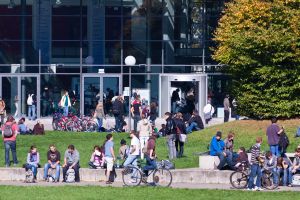
In the current winter semester, the number of students has reached a new maximum: About 22,500 students have enrolled at KIT. Of these, 5791 freshmen have started their studies. As compared to the past year, growth rates are very high in admission-free studies courses in informatics, civil engineering, and applied geosciences. These figures still are of preliminary character, as the deadline for statistics will be in late November.
Upon the completion of the enrolment phase, it is now clear: This is the highest number of students in the history of KIT and the former Universität Karlsruhe (TH). Compared to the past winter semester, about 2700 students more will be found on the campus. Of the 5791 freshmen, 1217 students are female. More than 1000 foreign students have decided in favor of studies at KIT. This increase in students is due to the abolition of compulsory military service and the doubled secondary graduation classes in Bavaria. “There is a particular demand for studies courses without restricted admission in this winter semester,” says Michael Kurth, Deputy Head of the Studies and Teaching Service Unit. About 600 students have enrolled in informatics. Here, the number of freshmen has nearly doubled. 120 students have enrolled in applied geosciences. Also here, figures have doubled. Civil engineering has attracted about 200 students more.
“We are very pleased about our high popularity among the freshmen. In mathematics, informatics, natural sciences, and engineering in particular, we urgently need well-trained young scientists in our country. We are glad that our programs of natural and engineering sciences are booked out this year,” says Professor Jürgen Becker, Chief Higher Education Officer at KIT. Becker underlines that further record figures are to be expected in 2012 due to the doubled final secondary school classes in Baden-Württemberg. Hence, there will be considerable need for rooms and large lecture halls in the next year.
In close partnership with society, KIT develops solutions for urgent challenges – from climate change, energy transition and sustainable use of natural resources to artificial intelligence, sovereignty and an aging population. As The University in the Helmholtz Association, KIT unites scientific excellence from insight to application-driven research under one roof – and is thus in a unique position to drive this transformation. As a University of Excellence, KIT offers its more than 10,000 employees and 22,800 students outstanding opportunities to shape a sustainable and resilient future. KIT – Science for Impact.