
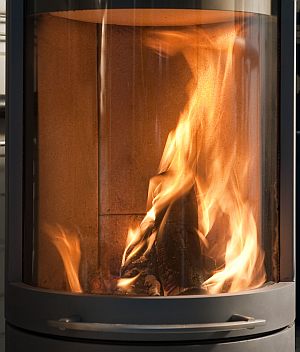
Exhaust gases and soot particles are produced by all combustion processes, also by wood-burning stoves. In cities and municipalities, these wood-burning stoves are major sources of emission of harmful finest particles. KIT has now developed a maintenance-free soot separator for the nearly complete removal of soot from exhaust gases of small combustion systems. This development was granted the innovation award by the Technologiefabrik Karlsruhe.
Due to increasing costs of natural gas and petroleum and for ecological reasons, combustion of CO2-neutral biomass, in particular of wood, gained attractiveness for private households in the past years. Like all combustion processes, also wood-burning stoves are producing exhaust gases and soot particles. Hence, these stoves are major sources of emission of harmful finest particles in cities and municipalities. All over Germany, wood-burning stoves and similar small combustion plants annually emit about 24,000 tons of fine dust. This corresponds to about the amount emitted by diesel vehicles in Germany. Consequently, an amendment of the 1st Federal Emission Protection Ordinance (1. BimSchV) became effective on March 22, where stricter limits are fixed for such particle emissions. This amendment first applies to new wood-burning stoves, but with defined deadlines it will also be valid for older systems later on. To comply with the new limit values, the installation of modern low-exhaust-gas combustion systems and backfitting of old systems with effective soot filters will be required.
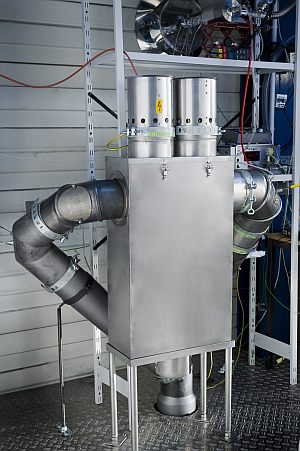
“We have now developed a pressure loss-free electrostatic soot separator for a maintenance-free and nearly complete removal of soot from exhaust gases of small combustion systems”, explains Dr. Hanns-Rudolf Paur, who heads the project at the Institute for Technical Chemistry of Karlsruhe Institute of Technology (KIT). “This is an ideal solution for cleaning exhaust gases of wood- or pellet-burning stoves, but also of other small combustion systems running on biomass.”
Wood-burning stoves are major sources of emission of harmful finest particles. (Photo: Karlsruhe Institute of Technology)
The technical solution is a novel so-called corona discharge, for which KIT was granted a patent. The soot particles are electrically charged in an ionization chamber and the charged particles can then be collected easily in a downstream earthed collector. For the separation of the charged particles in the collector, no external electric field is required. By a spiral brush that rotates in intervals, the collector is cleaned automatically and the deposited soot is collected in a collection tank. Due to this open design, the soot separator generates hardly any pressure loss and does not influence the stove function. Hence, it can be operated in an energy-efficient manner without additional measures being required. KIT is now looking for an industry partner to further develop the technically mature solution to a marketable product.
On March 23, 2010, the “Electrostatic Separator for Soot Particles in Wood Combustion” was granted the first prize in the innovation competition “Innovative Ideas Wanted!” of the Technologiefabrik Karlsruhe.
In close partnership with society, KIT develops solutions for urgent challenges – from climate change, energy transition and sustainable use of natural resources to artificial intelligence, sovereignty and an aging population. As The University in the Helmholtz Association, KIT unites scientific excellence from insight to application-driven research under one roof – and is thus in a unique position to drive this transformation. As a University of Excellence, KIT offers its more than 10,000 employees and 22,800 students outstanding opportunities to shape a sustainable and resilient future. KIT – Science for Impact.