
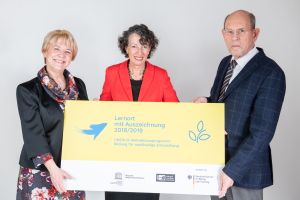
The German Federal Ministry for Education and Research (BMBF) and the German Commission for UNESCO (DUK) have honored Karlsruhe Institute of Technology (KIT) for its outstanding educational initiatives for sustainable development. The jury in particular praised KIT’s objective to develop into a more sustainable organization overall. The award ceremony took place on November 28, 2018 in Bonn.
Bicycle campus, real-life lab, climate and environmental research, and spring days of sustainability: there’s no lack of sustainable concepts, activities and ideas at KIT. With its size and technical direction, KIT is contributing significantly to a more sustainable future as a training facility for future players and decision-makers. The German Commission for UNESCO has now honored KIT as a “place of learning for sustainable development”. The application for the award was initiated by ZAK | Center for Cultural and General Studies at KIT in conjunction with the ZUKUNFTSCAMPUS office and the Karlsruhe School of Sustainability (KSS).
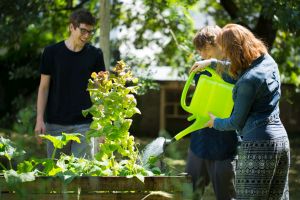
In teaching modules, projects and complementary “sustainable development” studies, ZAK has for many years been dealing with theoretical and conceptual perspectives of sustainability, providing appli
cation-oriented knowledge and skills for all students at KIT. “By addressing and debating the sustainability discourse in our public science teaching and events, we are helping raise awareness in society and develop a sense of responsibility for sustainable action beyond the boundaries of individual disciplines,” says the Director of ZAK Professor Caroline Y. Robertson-von Trotha who accepted the award from Secretary of State Christian Luft and President of the German Commission for UNESCO Professor Maria Böhmer.
To embed sustainability in teaching and research, the Karlsruhe School of Sustainability (KSS) and the Network Sustainability at KIT (NeNa) are bringing together players in one network. KSS is establishing an exchange between researchers, students and society through active innovative teaching formats. The aim is for all future graduates of KIT to develop capabilities that are needed to help shape sustainability transformations.
In addition to KIT’s teaching and participative approach, the jury also praised its sustainability management. Comprising around 9,300 employees and 25,500 students, KIT has a resource consumption equivalent to that of a small town. Therefore, KIT’s goal is to actively contribute to climate protection through its own actions. To achieve this, KIT has set up an office for sustainability, among other things. The ZUKUNFTSCAMPUS office develops sustainable projects and supports networking with science as well as participation of all the players to also embed sustainable actions within the organization.
About the UNESCO "Education for Sustainable Development" (ESD) Global Action Programme
Since 2016, BMBF and DUK have been honoring educational initiatives once a year as part of the national implementation of the UNESCO "Education for Sustainable Development" Global Action Programme. The selection is made by a jury comprising members of the national ESD platform, as well as representatives from BMBF, the Free University of Berlin and DUK. In addition to learning content, methods and processes, the honored players are using ESD as the framework for all actions in all areas of the institution. They are basing their own management on principles of sustainability, helping establish ESD in the German educational landscape.
In close partnership with society, KIT develops solutions for urgent challenges – from climate change, energy transition and sustainable use of natural resources to artificial intelligence, sovereignty and an aging population. As The University in the Helmholtz Association, KIT unites scientific excellence from insight to application-driven research under one roof – and is thus in a unique position to drive this transformation. As a University of Excellence, KIT offers its more than 10,000 employees and 22,800 students outstanding opportunities to shape a sustainable and resilient future. KIT – Science for Impact.