
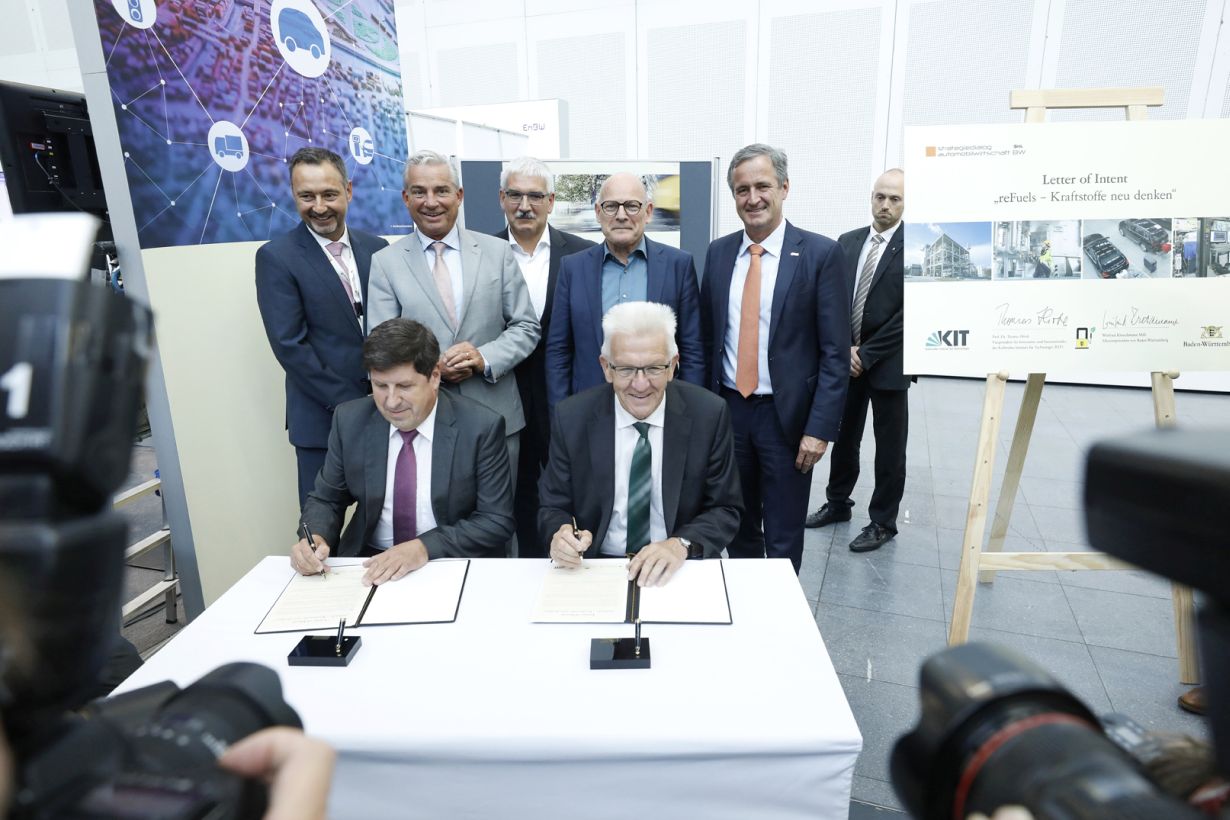
CO2 emissions from fossil fuel-based passenger and freight transport largely contribute to climate change. Synthetic fuels – so called reFuels – may also be produced from non-fossil carbon sources, such as biogenic residues, in combination with the direct conversion of CO2 and renewable hydrogen and may help protect global climate. Karlsruhe Institute of Technology (KIT) now plans to comprehensively study the opportunities associated with these fuels for society, industry, and the environment in cooperation with partners from automotive industry, automotive supply industry, and mineral oil industry and with the support of the Baden-Württemberg State Government. The corresponding letter of intent was recently signed in Stuttgart.
The “reFuels – Rethinking Fuels” project will focus on processes to produce on a large scale Otto and diesel fuels from sustainable resources, such as plant residues. Studies will also cover the impacts of regenerative fuels on pollutant emission of the existing fleet and on the function of the vehicles and their components. The ultimate goal of the project partners is to enhance the society’s and consumers’ acceptance of these novel fuels. This is what the state government and KIT agreed upon at the annual meeting for the Policy Dialogue on Automotive Industry in Stuttgart in July.
“To reach the declared climate goals, we need a smart mix of alternative drives. Efficient synthetic fuels from sustainable sources may open up a climate-neutral perspective for the combustion engine in the medium and long term,” said Minister-President Winfried Kretschmann. “Together with partners from automotive and supply industries, mineral oil industry, and civil society, we will now intensify research and, thus, make an important step towards climate-compatible mobility.”
Baden-Württemberg Minister of Transport Winfried Hermann said: “Synthetic fuels from regenerative sources might decisively contribute to the urgently required reduction of CO2 emissions in the transport sector in the future. Only when all instruments for climate protection in the transport sector will be used, can we reach the international goals agreed upon in Paris. Within the reFuels project, Baden-Württemberg will further develop the efficiency of such fuels and explore reasonable applications.”
“reFuels are an important milestone in closing the CO2 cycle,” said the President of KIT, Professor Holger Hanselka. “Climate change is one of the most urgent problems of society tackled by KIT. In the future, regenerative fuels may open up entirely new fields of business along the chain of values added,” Hanselka continued.
“As efficiency gains of gasoline and diesel engines were balanced by the increase in traffic in the past years and combustion engines will continue to play an important role in the transport of heavy loads and on longer distances in the foreseeable future, environmentally friendly and engine-compatible synthetic fuels can substantially enhance the sustainability of the transport sector,” said Professor Thomas Hirth, KIT Vice President for Innovation and International Affairs.
With bioliq and the Energy Lab 2.0, KIT already has two facilities for the production of reFuels. The bioliq facility produces high-quality fuels from biogenic feedstocks and residues, such as straw. The Energy Lab 2.0 that is presently under construction will consist of several plants and combine technologies for the production and use of electrical, thermal, and chemical energy, such as gas turbines, power-to-methane technology, and water electrolysis. Here, various fuel components, such as diesel fuels or jet fuels, will be produced.
The following partners already have agreed to participate in the reFuels project:
AUDI AG, Caterpillar Energy Solutions GmbH (MWM), Daimler AG, Eberspächer GmbH & Co. KG, Freudenberg Sealing Technologies GmbH & Co. KG, KS Kolbenschmidt GmbH, Mahle GmbH, Mann + Hummel GmbH, Dr. Ing. h.c. F. Porsche AG, Robert Bosch GmbH, Rolls-Royce Powersystems AG (MTU), as well as EnBW AG and MiRO GmbH & Co. KG with the support of the Petroleum Industry Association (MWV).
In close partnership with society, KIT develops solutions for urgent challenges – from climate change, energy transition and sustainable use of natural resources to artificial intelligence, sovereignty and an aging population. As The University in the Helmholtz Association, KIT unites scientific excellence from insight to application-driven research under one roof – and is thus in a unique position to drive this transformation. As a University of Excellence, KIT offers its more than 10,000 employees and 22,800 students outstanding opportunities to shape a sustainable and resilient future. KIT – Science for Impact.