
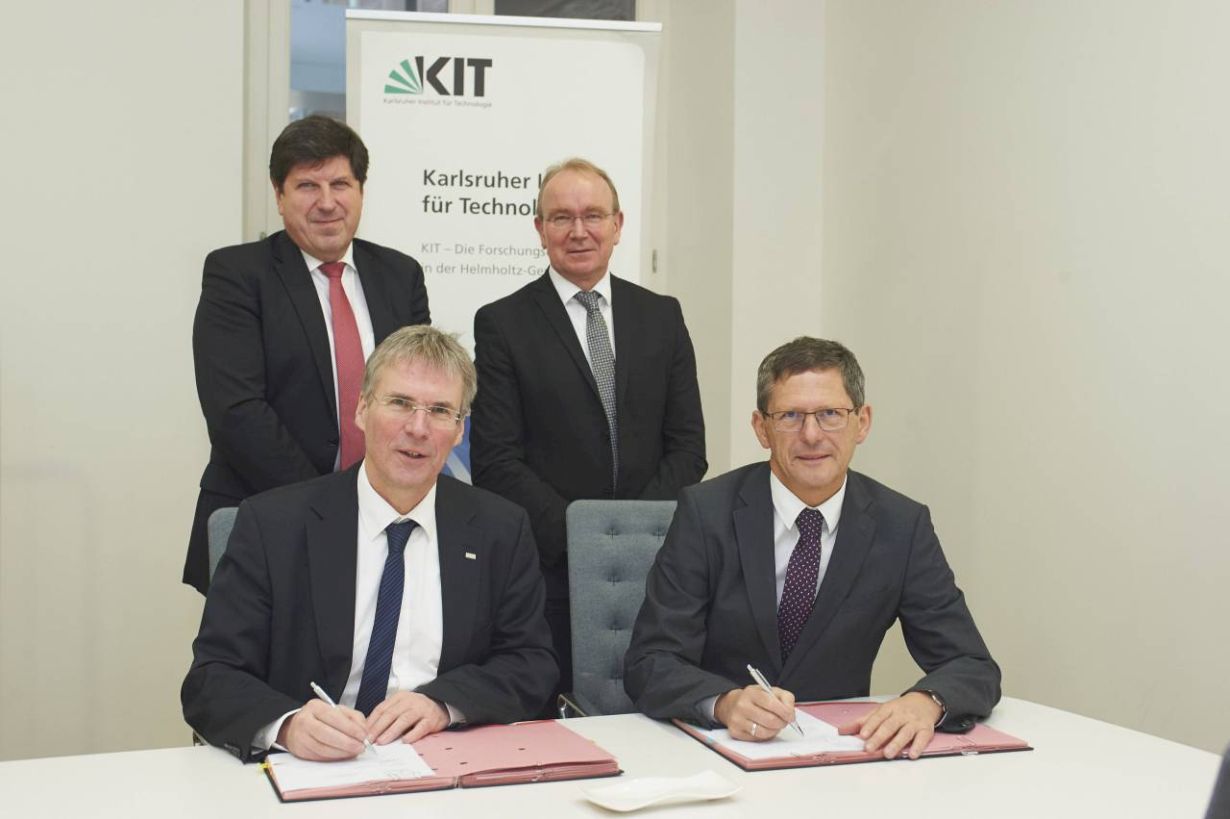
Digital change in work and life is one of the biggest and most pressing challenges facing our society. Karlsruhe Institute of Technology (KIT) and ZEISS are now working on shaping and advancing digitization. The industrial company and the research and education institution have decided to turn their existing, long-standing cooperation in research and academic education into a strategic partnership. Joint product development and establishment of startups will be shifted into the focus. The corresponding agreement was signed on Tuesday, January 23, 2018, in Karlsruhe.
The partners agreed on first concrete research projects in the areas of digitization and robotics. Work will concentrate on machine learning, digital optics, and computer vision applications. In addition, KIT and ZEISS plan to cooperate in academic education, innovation, advanced training, internationalization, recruiting, and university marketing as well as in the public dialog on technology development.
“Apart from energy and mobility, information is among the scientific strengths of KIT. Through research-based education, we prepare our students optimally for responsible tasks in society, science, and industry. The basis are the many good partnerships with industry,” said Professor Holger Hanselka, President of KIT, when signing the agreement. “The agreement with ZEISS will enable us to offer our students deeper practical insight in industry. As a result, our graduates will have very good career opportunities.”
“KIT as a strong partner will help us master future challenges in optoelectronics and digitization. We will contribute our practical experience. The tasks we have to cope with will become subject of research and education,” said Professor Michael Kaschke, President and CEO of the ZEISS Group. For instance, joint education formats with ZEISS experts will be offered to students at KIT.
Another important aspect of the framework agreement will be the utilization of joint research results by e.g. spinoffs. Presently, ZEISS is investing EUR 30 million in the construction of an innovation hub at KIT. “Research and innovation are to bridge the gap between findings and application. Startups of KIT will be given a longer-term perspective on site in a building covering 12,000 m². This will sustainably improve framework conditions for the entrepreneurs among our students and researchers,” said Professor Thomas Hirth, Vice President for Innovation and International Affairs of KIT.
More information on the hub:
http://www.kit.edu/kit/english/pi_2017_137_zeiss-invests-eur-30-million-in-innovation-hub-at-kit.php
In close partnership with society, KIT develops solutions for urgent challenges – from climate change, energy transition and sustainable use of natural resources to artificial intelligence, sovereignty and an aging population. As The University in the Helmholtz Association, KIT unites scientific excellence from insight to application-driven research under one roof – and is thus in a unique position to drive this transformation. As a University of Excellence, KIT offers its more than 10,000 employees and 22,800 students outstanding opportunities to shape a sustainable and resilient future. KIT – Science for Impact.