
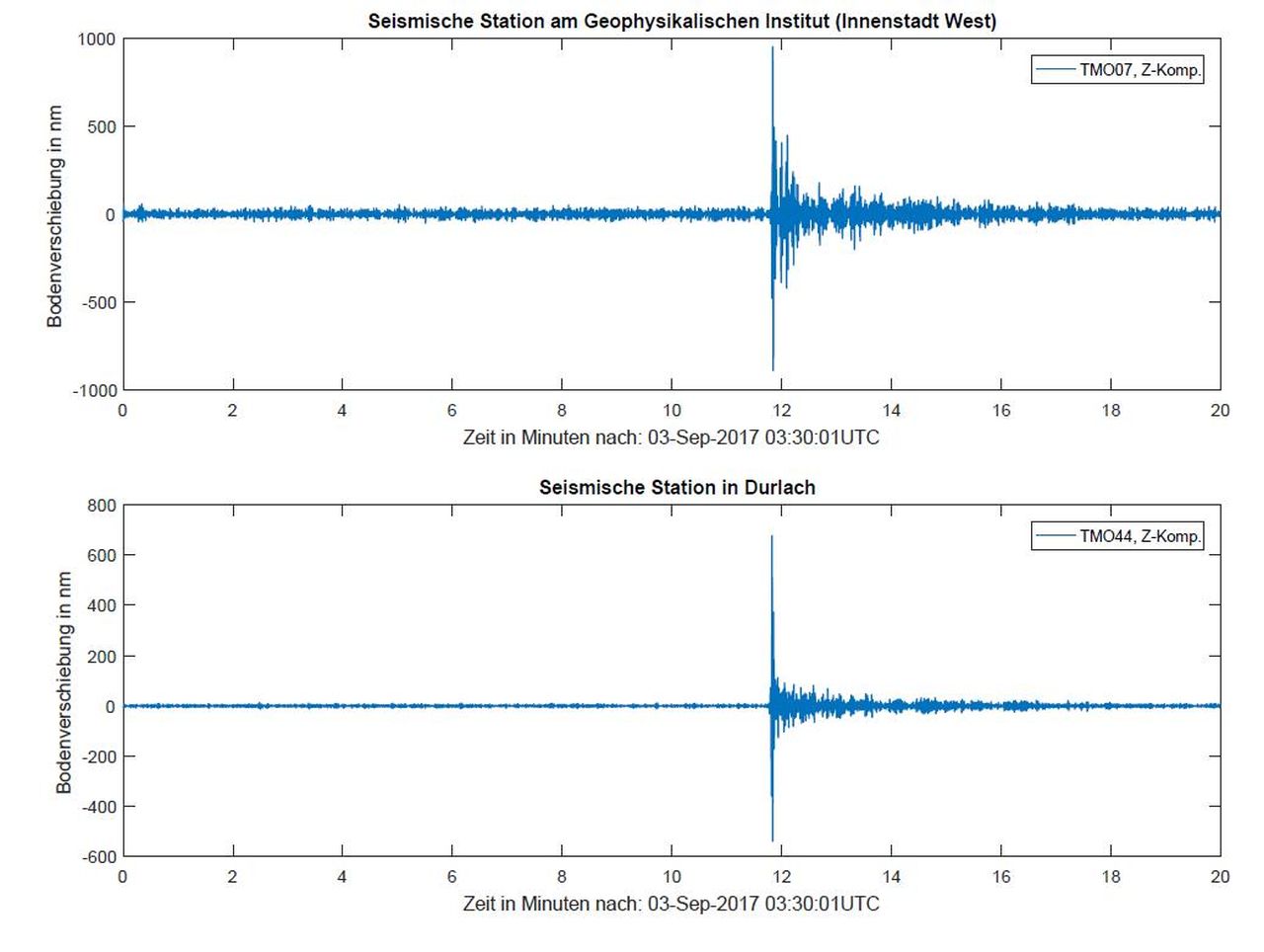
The recent nuclear test by the regime in North Korea was even measurable in Southwest Germany. Two seismic stations run by scientists of Karlsruhe Institute of Technology (KIT) in the Karlsruhe city center and in Durlach recorded vibrations of 6.3 in body wave magnitude in the night from Saturday to Sunday.
“This corresponds to about a moderate earthquake,” Toni Zieger of KIT’s Geophysical Institute (GPI) says. “However, the detonation could not be felt here,” Zieger explains. The stations that belong to the Karlsruhe Wide Band Array (KABBA) run by GPI are equipped with highly sensitive measurement instruments that perceive shocks worldwide. According to the Helmholtz Centre Potsdam (GFZ), the detonation in North Korea took place at 5.30 am (MEST) in the night from Saturday to Sunday. About twelve minutes later, the seismic waves arrived in Karlsruhe. They made the ground in Karlsruhe rise and subside by about one micrometer.
In close partnership with society, KIT develops solutions for urgent challenges – from climate change, energy transition and sustainable use of natural resources to artificial intelligence, sovereignty and an aging population. As The University in the Helmholtz Association, KIT unites scientific excellence from insight to application-driven research under one roof – and is thus in a unique position to drive this transformation. As a University of Excellence, KIT offers its more than 10,000 employees and 22,800 students outstanding opportunities to shape a sustainable and resilient future. KIT – Science for Impact.