
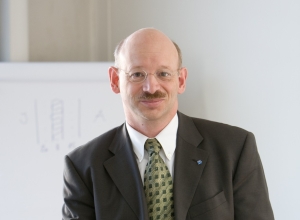
Bodo Ramelow, Minister-President of Thuringia, awarded the Officer’s Cross of the Order of Merit to Thomas Lützkendorf in Erfurt. Doing this, Ramelow honored the outstanding merits of the professor of Karlsruhe Institute of Technology (KIT) in the development of scientific principles for sustainable construction and their dissemination and implementation in practice.
Sustainable, i.e. energy-efficient, resource-friendly, healthy, and economically efficient, construction has many advantages. It does not only contribute to preserving the environment, but also results in a high satisfaction of users and gives rise to economic potentials. The question of how ecological can be combined with economic aspects for the benefit of all parties involved is in the focus of research conducted by Thomas Lützkendorf, Holder of the Chair of Sustainable Management of Housing and Real Estate of KIT’s Department of Economics and Management. With his work, Thomas Lützkendorf essentially contributed to establishing methodological principles that are indispensable for assessing the viability of a building.
When handing over the Officer’s Cross of the Order of Merit at the Thuringian State Chancellery, Minister-President Ramelow mentioned the work of Thomas Lützkendorf relating to national and international standardization, his participation in various advisory councils and bodies, such as the round table on “Sustainable Construction” of today’s Federal Ministry of Transport and Digital Infrastructure, his work in the International Initiative for a Sustainable Built Environment (iiSBE), and his support of the international SBE conference series as important contributions to sustainable development. In particular, Lützkendorf’s commitment to the environment and society was honored.
About the Person
Thomas Lützkendorf studied at the Faculty of Civil Engineering of today’s Bauhaus University in Weimar and completed his studies in 1981 as a civil engineer. Then, he worked as a research fellow at the Department of Economics in the Construction Sector and completed his doctorate on the description, assessment, and optimization of buildings’ energy demand in 1985.
Following a period of practical work in construction project management and as a visiting researcher at ETH Lausanne, Lützkendorf was post-doctoral research fellow at the Institute for Building Ecology and Building Climate of the Department of Architecture of the University of Weimar. He received his post-doctoral lecture qualification in 2000 with a thesis on the implementation of sustainable development principles within the construction sector.
In 2000, Lützkendorf was appointed professor of the University of Karlsruhe, today’s Karlsruhe Institute of Technology, and has been holding the Chair of Sustainable Management of Housing and Real Estates since then. The Chair belongs to the KIT Department of Economics and Management, but is also associated with KIT’s Department of Architecture.
In education and research as well as DIN committee chairman and expert of the round table on “Sustainable Construction”, Thomas Lützkendorf is concerned with questions relating to the implementation of sustainable development principles in the construction and property industries. His work focuses on the further development and application of lifecycle analyses and ecobalances, on the design of information flows along the chain of values added, and on the integration of sustainability aspects into risk analysis, valuation, and portfolio management. Lützkendorf was and currently is involved in the development and testing of sustainability assessment systems for buildings (BNB, DGNB, NaWoh).
Thomas Lützkendorf is founding member of the International Initiative for a Sustainable Built Environment (iiSBE).
In close partnership with society, KIT develops solutions for urgent challenges – from climate change, energy transition and sustainable use of natural resources to artificial intelligence, sovereignty and an aging population. As The University in the Helmholtz Association, KIT unites scientific excellence from insight to application-driven research under one roof – and is thus in a unique position to drive this transformation. As a University of Excellence, KIT offers its more than 10,000 employees and 22,800 students outstanding opportunities to shape a sustainable and resilient future. KIT – Science for Impact.