
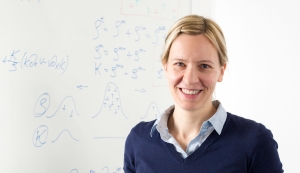
Dr. Katrin Schulz, Karlsruhe Institute of Technology (KIT), has been selected for funding under the Margarete von Wrangell program for post-doctoral lecture qualification. Under this program, the state of Baden-Württemberg supports excellent female researchers on their way to professorship. Engineer and materials scientist Katrin Schulz works on modeling plastic deformations in metal materials on the microscale. Predicting deformations as a function of size is important when e.g. customizing metal microstructures for special applications.
When developing new materials and designing components, it is important to know how and under which conditions a structure deforms. Dr. Katrin Schulz works at the KIT Institute for Applied Materials – Computational Materials Science (IAM-CMS) and focuses on computerized models to reliably predict deformations, in particular plastic, i.e. permanent deformations. Katrin Schulz heads the group “Continuum Formulation of Dislocation-based Crystal Plasticity” to model plastic processes in metal materials on the microscale.
In the micrometer range, many materials possess surprising properties that may turn out to be rather useful in special applications, such as a high strength or stability. Meanwhile, materials scientists are able to tailor clearly defined metal microstructures to certain applications. Doing this, it is indispensable to model the deformation behavior as a function of size.
Metals consist of regularly arranged atoms that form a crystal lattice. As a result of certain crystal defects, so-called dislocations, they become plastically deformable. Dislocations can be moved through the material until a certain shape is reached. Movement of a dislocation is determined by the local stress state that depends on external load and stress fields of other dislocations. Also grain boundaries or inclusions may inhibit deformations.
In cooperation with the DFG Research Group “Dislocation-based Plasticity” headed by Professor Peter Gumbsch, holder of the Chair for Mechanics of Materials of IAM-CMS, KIT, the group of Dr. Katrin Schulz studies interactions between dislocations, grain boundaries, and other phenomena. To simulate microstructures, the scientists use the “Continuum Dislocation Dynamics” (CDD) theory developed by the DFG group. This theory considers metals to be a continuum and uses information on dislocations for the size-dependent prediction of deformations.
About the Margarete von Wrangell Program
The Margarete von Wrangell post-doctoral lecture qualification program is aimed at encouraging and supporting qualified female scientists on their way to professorship. Support covers funding of staff for a duration of up to five years. The Baden-Württemberg Ministry of Science, Research, and the Arts (MWK) funds the position of the female scientist for three years. Then, funding is continued by the respective university for a period of two years. In addition to their research work, the scientists selected for the funding program are to lecture four hours per week.
In close partnership with society, KIT develops solutions for urgent challenges – from climate change, energy transition and sustainable use of natural resources to artificial intelligence, sovereignty and an aging population. As The University in the Helmholtz Association, KIT unites scientific excellence from insight to application-driven research under one roof – and is thus in a unique position to drive this transformation. As a University of Excellence, KIT offers its more than 10,000 employees and 22,800 students outstanding opportunities to shape a sustainable and resilient future. KIT – Science for Impact.