
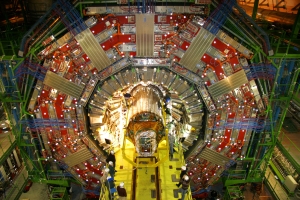
Which size and mass do the smallest particles of our universe have? How can such values be measured and which relevance do the new findings have – not only for science? These questions will be covered by scientists of the KIT Elementary Particle and Astroparticle Physics Center (KCETA) on Tuesday, January 20, 2015, at 18.30 hrs. At the Karlsruhe city hall, they will present exciting research relating to the Higgs particle and neutrino.
The presesentations will be made in the German language with a simultaneous translation into sign language. Parallel to the event, an exhibition of the KIT Elementary Particle and Astroparticle Physics Center will be organized in the upper hall of the City Hall from January 19 to 23, 2015.
[…]
More information: www.zak.kit.edu/kit_im_rathaus
In close partnership with society, KIT develops solutions for urgent challenges – from climate change, energy transition and sustainable use of natural resources to artificial intelligence, sovereignty and an aging population. As The University in the Helmholtz Association, KIT unites scientific excellence from insight to application-driven research under one roof – and is thus in a unique position to drive this transformation. As a University of Excellence, KIT offers its more than 10,000 employees and 22,800 students outstanding opportunities to shape a sustainable and resilient future. KIT – Science for Impact.