
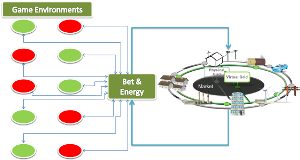
Sports bets were yesterday. In the future, bets will be made with utilities on the electricity bill. Saving power production costs in an indirect and playful manner is the idea of three young scientists from Karlsruhe and Munich. Martin Alexander Neumann and Yong Ding, Karlsruhe Institute of Technology (KIT), and Georg Hackenberg, Technische Universität München (TUM), jointly developed the social game “Bet and Energy”. The system supported by intelligent electricity meters is not only intended to be fun, but to help households and utilities save electricity. With this concept, the team has now won the SAP “Utility of Tomorrow Innovation Contest”.
Using elements typical of a game in a context that has nothing to do with games is referred to as “gamification.” “Bet and Energy” is based on this principle. Whoever reduces the production costs of the utilities by an adapted personal behavior can reduce the electricity bill. In bets, consumers agree with their utilities not to do the laundry during the day or not to watch TV in the evening, for instance. In this way, private persons are given an incentive not to use less energy, but to consume it at unusual times. Consumers are encouraged to do the so-called “load shifting”. “Our system offers a clear value added for all parties involved. Energy costs are an important factor for every household and every company. Changes of behavior of many people in a region may reduce the energy production costs of their utility. In return, the utility can pass these cost reductions on to the consumers when billing electricity costs at the end of the month,” Martin Alexander Neumann and Yong Ding of the TECO Research Group at the KIT Institute of Telematics explain. To establish the system on the market, however, smart electricity meters will have to be applied routinely. With their help only can it be determined when the time of consumption is most favorable and how much electricity can be saved.
International Success for “Bet and Energy”
This idea has now won the “Utility of Tomorrow Innovation Contest” of SAP. In this international competition, the team won over 60 other pre-selected proposals. All teams had to submit their ideas of mobile applications for future energy supply in various categories. As one of five winner teams, the group will now participate in a SAP workshop of one week duration in the USA. There, the idea shall be analyzed for feasibility in more detail and a first prototype shall be developed.
Cooperation of the three scientists from Karlsruhe and Munich started in the Software Campus project funded by the Federal Ministry of Education and Research (BMBF). Under that project, young scientists were to be trained to become tomorrow’s IT executives through advanced training programs and cooperation with industry.