
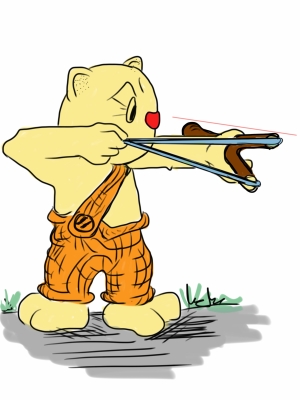
As a child, we all constructed slingshots for shooting on empty cans. But a slingshot is much more than a toy. It may also provide access to physics and mechanical engineering. Energy storage, efficiency, and dynamics can be made understandable based on slingshot technology. It is the subject of the latest book of Professor Claus Mattheck, “Die Mechanik der Schleuder – erläutert mit einfühlsamen Worten von Pauli dem Bär” (The Mechanics of the Slingshot – Explained Empathetically by Pauli, the Bear).
If we had known as a child how much science and technology are involved in building a slingshot and shooting with it, we would probably have given up downheartedly. It worked somehow, but the result would have been better, if we had known more. The studies made by Professor Claus Mattheck from the Biomechanics Division of Karlsruhe Institute of Technology may help and, at the same time, provide insight into science and engineering.
Selection of an appropriate material for the slingshot body provides the opportunity for an excursion to component optimization and the biomechanics of trees. The setup and fixing of the elastic band with the leather bag are connected with materials research, joining techniques, and wear. When shooting, ballistics becomes important: Acceleration, air resistance, and gravity determine the trajectory.
All this is covered by the latest book of Claus Mattheck. Clear descriptions are only one part of the book. In-depth investigation of all aspects covered is possible with the help of the theoretical annex that contains basic formulas. High-speed recordings illustrate the acceleration of the bullet, a process of repeated pushing rather than of steady character. Many drawings and diagrams describe the optimum shot and the mistakes that can be made. None the least, safety plays an important role for the protection of the user of the slingshot and his environment.

The cover of the book “Die Mechanik der Schleuder – erläutert mit einfühlsamen Worten von Pauli dem Bär” (The Mechanics of the Slingshot – Explained Empathetically by Pauli, the Bear) by Professor Claus Mattheck.
The book “Die Mechanik der Schleuder – erläutert mit einfühlsamen Worten von Pauli dem Bär” (The Mechanics of the Slingshot – Explained Empathetically by Pauli, the Bear) is published by Karlsruhe Institute of Technology (ISBN 978-3-923704-83-5, more than 100 pages with colored drawings, 14 cm x 15 cm, paperback, 20 Euros) and may be ordered via the internet.
In close partnership with society, KIT develops solutions for urgent challenges – from climate change, energy transition and sustainable use of natural resources to artificial intelligence, sovereignty and an aging population. As The University in the Helmholtz Association, KIT unites scientific excellence from insight to application-driven research under one roof – and is thus in a unique position to drive this transformation. As a University of Excellence, KIT offers its more than 10,000 employees and 22,800 students outstanding opportunities to shape a sustainable and resilient future. KIT – Science for Impact.