
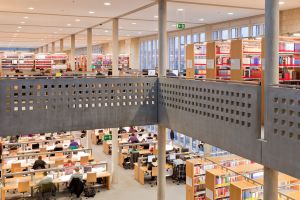
The library of Karlsruhe Institute of Technology (KIT) is one of the scientific libraries ranked best in Germany. In the library index (BIX) determined annually by the Bertelsmann Foundation and the German Association of Libraries, the KIT library is ranked in third place of 15 in the category of two-shift university libraries with a Central Library and independent institute libraries.
The KIT Library is given excellent ratings for its infrastructure and cost efficiency. Among the criteria for evaluating the performance of libraries all over Germany also are the utilization rate and development potential. With its third place behind the university libraries of Heidelberg and Göttingen, the Karlsruhe Library improved by one place compared to the ranking of last year. “The good ranking of the KIT Library in the BIX above all reflects the extraordinary commitment of the staff,” emphasizes Frank Scholze, director of the KIT Library. The KIT Library comprises both central libraries on Campus North, the former Forschungszentrum Karlsruhe, and Campus South, the former university. It has an inventory of two million books and research reports as well as 28,000 journals. “We jointly participated in and designed the successful merger process and reorientation of our information services for research, education, and innovation at KIT during day-to-day business,” says Scholze.
Together with a network of decentralized partial libraries, the KIT Library supplies 25,000 students and 8,000 scientists with information for research and education. The collection of literature focusing on natural sciences and engineering is also available to the interested public. In 2006, the KIT Library opened the first fully automatic 24 hour library in Germany.
Presently, a comprehensive research information system is established at KIT for the documentation of publications, projects, and innovations. On November 22 and 23, 2011, the KIT Library, together with the Institute for Research Information and Quality Assurance and the German Initiative for Network Information (DINI), will organize a workshop on this topic. Experts from several universities and research associations are expected to come to Karlsruhe.
In close partnership with society, KIT develops solutions for urgent challenges – from climate change, energy transition and sustainable use of natural resources to artificial intelligence, sovereignty and an aging population. As The University in the Helmholtz Association, KIT unites scientific excellence from insight to application-driven research under one roof – and is thus in a unique position to drive this transformation. As a University of Excellence, KIT offers its more than 10,000 employees and 22,800 students outstanding opportunities to shape a sustainable and resilient future. KIT – Science for Impact.