
The Celitement® environmentally compatible cement developed by Karlsruhe Institute of Technology (KIT) is granted the Baden-Württemberg Special Environmental Technology Award. From today’s perspective, Celitement® will require only half of the energy for production and carbon dioxide (CO2) emission into the environment will be halved compared to conventional processes. The new cement is presently being further developed to maturity by Celitement GmbH, a spin-off of the four inventors, KIT, and the industry partner, SCHWENK Zement KG.
Every two years, the Baden-Württemberg Ministry of the Environment, Climate Protection, and the Energy Sector grants the Environmental Technology Award to excellent and innovative environmental technology products in four categories. The special award of the jury considers current challenges in environmental policy and is granted to Celitement GmbH this year.
Cement production is an energy-consuming process. Annually, cement works emit about three billion tons of the greenhouse gas carbon dioxide, corresponding to five to seven percent of the worldwide CO2 emissions. Hence, CO2 emission of cement production exceeds that of worldwide air traffic by a factor of 3 - 4.
Compared to conventional cement production processes, the new cement promises to result in enormous reductions of energy consumption and presumably half of the CO2 emissions. Celitement® also saves resources, as only one third of the amount of limestone is required compared to conventional Portland cement and no gypsum additive is needed.
The new pilot plant produces 100 kg of Celitement® daily. (Photo: Markus Breig)
“Celitement® has the potential of replacing conventional cement in many areas in the long term”, emphasizes Dr. Hanns-Günther Mayer, one of the managing directors of Celitement GmbH. First, the KIT scientists produced Celitement® on the laboratory scale. After more than one year of extensive and highly successful testing, Celitement GmbH started to build a pilot plant on KIT Campus North with an investment volume of EUR 5 million last year. From autumn 2011, this pilot plant will supply 100 kg of Celitement® daily. “This will be another big step towards the maturity of this environmentally compatible cement,” says Mayer.
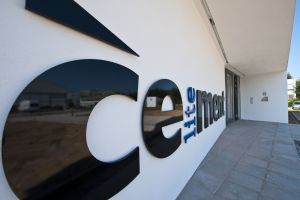
The new building of Celitement GmbH on KIT Campus North. (Photo: Markus Breig)
“With energy- and material-efficient processes and products, enterprises in Baden-Württemberg can reduce costs enormously, increase their competitiveness, and open up new, strongly growing markets worldwide,” explains Franz Untersteller, Minister for the Environment, Climate Protection, and the Energy Sector of Baden-Württemberg. “With the Environmental Technology Award, we wish to point the way by focusing attention on enterprises and their innovations to save resources and protect the environment.”
The award ceremony will take place today from 18.00 to 20.00 hrs at the Römerkastell Stuttgart-Bad Cannstatt.
Further information on Celitement® is available at: www.celitement.de
Further information on the Baden-Württemberg Environmental Technology Award: http://www.umwelttechnikpreis.de/utp/de/ .
Karlsruhe Institute of Technology (KIT) is one of Europe’s leading energy research establishments. The KIT Energy Center pools fundamental research with applied research into all relevant energy sources for industry, households, services, and mobility. Holistic assessment of the energy cycle also covers conversion processes and energy efficiency. The KIT Energy Center links competences in engineering and science with know-how in economics, the humanities, and social science as well as law. The activities of the KIT Energy Center are organized in seven topics: Energy conversion, renewable energies, energy storage and distribution, efficient energy use, fusion technology, nuclear power and safety, and energy systems analysis.
In close partnership with society, KIT develops solutions for urgent challenges – from climate change, energy transition and sustainable use of natural resources to artificial intelligence, sovereignty and an aging population. As The University in the Helmholtz Association, KIT unites scientific excellence from insight to application-driven research under one roof – and is thus in a unique position to drive this transformation. As a University of Excellence, KIT offers its more than 10,000 employees and 22,800 students outstanding opportunities to shape a sustainable and resilient future. KIT – Science for Impact.