
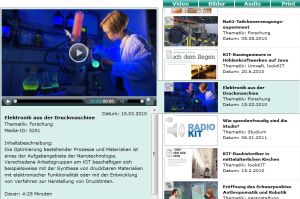
Public interest in science is growing constantly, also in complex issues. To explain these in a clear manner, KIT now offers a media library. By a few clicks, people interested in science are given a multi-media insight into the activities of KIT – by photos, video, audio, and printed contributions.
The media library is the multi-media display window of KIT. It presents achievements in research, education, and innovation. Users can access video, audio, and printed contributions as well as a photo archive. The topics covered range from visionary researchers to students and their campus life to production of parts at the workshop. The editorial staff of the media library deliberately addresses the broad public interested in science. In addition, contents are offered, which are of particular interest to the young public or journalists.
The Public Relations and Marketing Service Unit (PKM) was responsible for the implementation of the media library. Support was given by the Steinbuch Centre for Computing (SCC) and the library at KIT. Klaus Rümmele, Head of the PKM New Media Division, underlines the importance of the new media library: “It is clearly demonstrated by studies that scientific online appearances are more successful when they use multi-media. Today’s demanding public wishes to see how a robot moves and to listen how researchers explain their projects in their own words.”
In the future, the media library will also focus on the project “Inside Science” of the German Research Foundation, under which collaborative research centers of KIT, the Center for Applied Cultural Science and Studium Generale (ZAK), and PKM break new grounds in public science. It is aimed at illustrating complicated developments in research by partly animated videos. By means of visualization, also the layman shall be enabled to understand what happens in a controlled particle collision, for example, or how a robot works.
The editorial staff considers a link between the media library and social networks on the internet very important. “In the future, we would like to give the users the opportunity to give their comments on our contributions via Facebook or Twitter,” says Rümmele. “This enhances exchange between science and the public and will help us as communicators to constantly improve our offer. The media library shall grow continuously.”
The media library can be found on the internet at:
http://www.kit.edu/visit/medialibrary.php
In close partnership with society, KIT develops solutions for urgent challenges – from climate change, energy transition and sustainable use of natural resources to artificial intelligence, sovereignty and an aging population. As The University in the Helmholtz Association, KIT unites scientific excellence from insight to application-driven research under one roof – and is thus in a unique position to drive this transformation. As a University of Excellence, KIT offers its more than 10,000 employees and 22,800 students outstanding opportunities to shape a sustainable and resilient future. KIT – Science for Impact.