
A junior research group at KIT develops novel methods to measure the concentration of carbon dioxide and methane in the atmosphere of the Earth. Their findings shall contribute to counteracting climate change. The research project “Remote Sensing of Greenhouse Gases for Carbon Cycle Modeling” of the physicist Dr. André Butz will be organized as an Emmy
Noether junior research group at the Institute of Meteorology and Climate Research – Atmospheric Trace Gases and Remote Sensing (IMK-ASF). The German Research Foundation (DFG) will provide funds to cover staff and materials expenses for a period of five years.
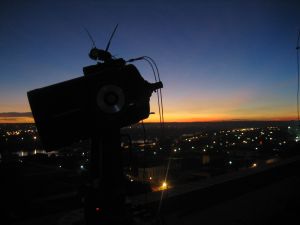
The research project “Remote Sensing of Greenhouse Gases for Carbon Cycle Modeling“, or briefly “RemoteC“, evaluates satellite data on short-wave infrared radiation scattered back from the Earth and the atmosphere. To increase the accuracy of interpretation, the data from space are combined with measurements at ground
stations.
It is aimed at developing a method to determine globally where, how much, and at which time methane and carbon dioxide are released into or removed from the atmosphere by natural processes. The greenhouse gases methane and carbon dioxide contribute significantly to climate change by heating up the Earth’s surface and the atmosphere. With the help of “RemoteC”, the scientists wish to answer important questions: Which role do the tropics play for the concentration of greenhouse gases in the atmosphere? How do arctic marshes and melting permafrost zones influence the greenhouse gas balance? Is it possible to counteract climate change by modified land use?
“The challenge consists in the fact that measurement and evaluation of the data have to be highly accurate,” explains Dr. André Butz. In the past four years, the 32-year-old physicist born at Coburg developed software for the evaluation of satellite data as a post-doc at the Netherlands Institute for Space Research. After his studies of physics at the University of Würzburg and the State University of New York, he wrote his Ph. D. thesis at the Université Pierre et Marie Curie, Paris, and the University of Heidelberg. Physicists and meteorologists will cooperate under the “RemoteC” project initiated and headed by Butz.
The international reviewers chosen by DFG unanimously approved of the project proposed by Butz and expressly prized the KIT and IMK-ASF as an excellent work environment for the Emmy Noether junior research group. Butz considers the IMK-ASF an “ideal” location of his project, as several excellent institutes cooperate at KIT. With the Emmy Noether program, DFG funds excellent young scientists who wish to qualify as scientific executives. Young post-docs with research experience abroad shall be won for research in Germany.
In close partnership with society, KIT develops solutions for urgent challenges – from climate change, energy transition and sustainable use of natural resources to artificial intelligence, sovereignty and an aging population. As The University in the Helmholtz Association, KIT unites scientific excellence from insight to application-driven research under one roof – and is thus in a unique position to drive this transformation. As a University of Excellence, KIT offers its more than 10,000 employees and 22,800 students outstanding opportunities to shape a sustainable and resilient future. KIT – Science for Impact.