
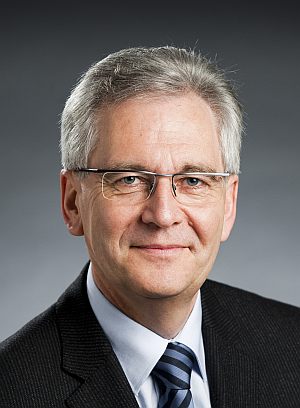
Today, Dr.-Ing. Peter Fritz, Vice President for Research and Innovation of Karlsruhe Institute of Technology, was elected Vice President of the German Atomic Forum (DAtF) for Science and Research. The second Vice President responsible for industry and manufacturers is Ulrich Gräber, AREVA NP, Nuremberg. Dr. Ralf Güldner, E.ON Kernkraft GmbH, Hanover, is the newly elected President of the German Atomic Forum.
“With this management structure, the German Atomic Forum covers major aspects of nuclear energy”, says Peter Fritz. “The DAtF wishes to strengthen the dialog with society and improve the representation of all member enterprises.”
Peter Fritz studied mechanical engineering and specialized in power plant and process technology at the University of Hanover. After his Ph. D., he worked for 17 years in the managements of international plant and power plant construction companies, before he was appointed Member of the Board of the former Forschungszentrum Karlsruhe on April 01, 1999. There, he was responsible for energy research from renewable energies to conventional power plant technology to fusion technology. In addition, he was in charge of environmental and microsystems technologies. With the merger of Forschungszentrum Karlsruhe and Universität Karlsruhe into Karlsruhe Institute of Technology (KIT), Fritz was appointed Vice President for Research and Innovation. Dr. Fritz is member of various advisory councils and committees of environmental, technical, and nuclear institutions.
In close partnership with society, KIT develops solutions for urgent challenges – from climate change, energy transition and sustainable use of natural resources to artificial intelligence, sovereignty and an aging population. As The University in the Helmholtz Association, KIT unites scientific excellence from insight to application-driven research under one roof – and is thus in a unique position to drive this transformation. As a University of Excellence, KIT offers its more than 10,000 employees and 22,800 students outstanding opportunities to shape a sustainable and resilient future. KIT – Science for Impact.