
Due to their high lightweight construction potential, carbon fiber-reinforced composites are increasingly applied in aerospace technology and automotive construction. The HEPHAISTOS microwave system developed by KIT allows for energy-efficient curing. Within the framework of a joint project of four years duration with international partners, which is funded by BMBF, the technology has now been used for the first time in an industrial test facility. The plant was commissioned recently by the company of GKN Aerospace, Munich.
The HEPHAISTOS technology represents an energy-efficient novel hardening method for composites without circulating air ovens, pressure chambers, or expensive heated tools. This microwave technology implies a unique physical process that can heat up a component over its entire volume at the same time. Based on developments of Karlsruhe Institute of Technology, homogeneous microwave fields can now be generated for the first time in chambers of any size. By means of an adequate control, the energy enters the components very rapidly and efficiently. Curing of polymer matrix systems, foams, or adhesives is accelerated considerably.
“The HEPHAISTOS technology is in the focus of a joint project of four years duration, which is funded by the Federal Ministry of Education and Research with a total amount of EUR 6 million”, says the project head, Priv.-Doz. Dr. habil. Lambert Feher from the KIT Institute for Pulsed Power and Microwave Technology. “For the first time, we have now commissioned a large plant at an industry client, the company of GKN Aerospace, Munich.”
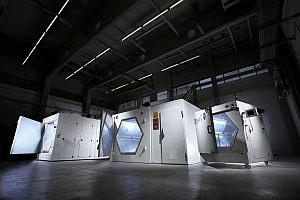
A large test center for the industrial use of the microwave technology for composites was established at KIT. (Photo: KIT)
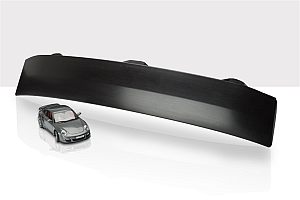
Currently, many other applications are being opened up. It is studied among others to what an extent the HEPHAISTOS technology can be applied to produce high-quality surfaces according to specifications of automotive industry. Meanwhile, a first car body part made of carbon fiber-reinforced composites has been hardened successfully with the HEPHAISTOS technology in cooperation with the Dr. Ing. h.c. F. Porsche AG.
Project partners of the joint project “Optimized Production of Fiber Composites with Modular Microwave Curing Systems” funded by the Federal Ministry of Education and Research with an amount of EUR 6 million are the aerospace companies EADS and GKN Aerospace, the chemical companies of BASF and Hexion, the automotive manufacturer Porsche, and the composite manufacturers SGL Carbon and Fritzmeier Composites.
Karlsruhe Institute of Technology (KIT) is one of Europe’s leading energy research establishments: The KIT Energy Center pools fundamental research with applied research into all relevant energy sources for industry, households, services, and mobility. Holistic assessment of the energy cycle also covers conversion processes and energy efficiency. The KIT Energy Center links competences in engineering and science with know-how in economics, the humanities, and social science as well as law. The activities of the KIT Energy Center are organized in seven topics: Energy conversion, renewable energies, energy storage and distribution, efficient energy use, fusion technology, nuclear power and safety, and energy systems analysis.
In close partnership with society, KIT develops solutions for urgent challenges – from climate change, energy transition and sustainable use of natural resources to artificial intelligence, sovereignty and an aging population. As The University in the Helmholtz Association, KIT unites scientific excellence from insight to application-driven research under one roof – and is thus in a unique position to drive this transformation. As a University of Excellence, KIT offers its more than 10,000 employees and 22,800 students outstanding opportunities to shape a sustainable and resilient future. KIT – Science for Impact.