
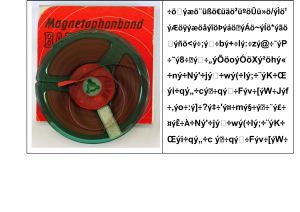
The KIT-Archives celebrate their 25th anniversary. Founded in 1985 as University Archives, it has also been responsible for archiving the documents from the large-scale research sector of KIT, since the foundation of Karlsruhe Institute of Technology (KIT) in 2009, Today, digital archiving makes universities and scientific institutions increasingly face new challenges. For this reason, this subject will be in the focus of the colloquium of the KIT-Archives on Thursday, December 09. Journalists are cordially invited.
The colloquium will take place from 9.30 hrs to 15.30 hrs at the Seminarraum 1, AudiMax (building 30.95, Straße am Forum 1, 1st floor) on KIT Campus South.
Since its foundation in 1985, work of the former University Archives has been characterized by the setup of archival inventories and finding aids and an infrastructure for the use of the Archive’s holdings. “Anniversaries of janiform archives, whose work consists in viewing the past and the future, should not be dedicated to retrospect exclusively,” emphasizes Dr. Klaus Nippert, Head of the KIT- Archives. He underlines that smaller institutions like archives of universities and scientific institutions are presently facing new challenges due to the changes in archiving.
Digital documents require other procedures and resources for archiving than conventional files, photos, magnetic tapes, and films. It is the objective of an archive to establish a credible and usable record of history. As digital documents can be modified easily and without a trace, archives have to fulfill new requirements in this field. It is necessary to ensure the authenticity of digital objects by special organizational and technical means. Moreover, the rapid change in the field of media formats and programs requires measures to preserve the understandability and essential properties of the archived material.
“Even large archives usually cannot fulfill the resulting tasks on their own. Cooperation with stakeholders that safely store data and support by experts knowing how to handle obsolete data formats and programs are required,” says Nippert. Archives of research and teaching institutions do not only have the legal task of archiving well- formed aggregations of digital administrative documents, they also have to handle digital single pieces and unstructured data from inherited remains. Primary research data are a type of material of its own. They meet with increasing interest not only because of the verifyability of the research results, but also because of their later value of use. Examples are climate data and documentations of threatened cultural assets.
Program
9.30 Dr. Alexander Kurz / KIT Presidential Committee
Welcome address
9.45 Dr. Klaus Nippert, Head of the KIT Archive
Retrospect and outlook on the work of the KIT Archive
10.15 Dr. Christian Keitel / Baden-Württemberg State Archive
Collected questions and some answers. Remarks on digital archiving in university archives with subsequent discussion
11.30 Coffee break
12.00 Dr. Stefan Winkler-Nees / German Research Foundation
Research data: Securing – archiving – supply with subsequent discussion
13.15 Break and possibility to have lunch
14.15 Dr. Robert Hauser / Karlsruhe Institute of Technology; Jürgen Enge / Karlsruhe University of Arts and Design
What can the Kompetenzzentrum für kulturelle Überlieferung – digital Karlsruhe (Competence Center for Cultural Tradition – digital Karlsruhe) do? An introduction to preserving and recording complex digital objects of second order
Discussion; end about 15.30 hrs.
In close partnership with society, KIT develops solutions for urgent challenges – from climate change, energy transition and sustainable use of natural resources to artificial intelligence, sovereignty and an aging population. As The University in the Helmholtz Association, KIT unites scientific excellence from insight to application-driven research under one roof – and is thus in a unique position to drive this transformation. As a University of Excellence, KIT offers its more than 10,000 employees and 22,800 students outstanding opportunities to shape a sustainable and resilient future. KIT – Science for Impact.