
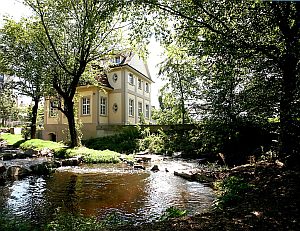
Continuance of the WWF-Auen-Institut (WWF Institute for Floodplains Ecology), Rastatt, is secured. Karlsruhe Institute of Technology (KIT) and the environmental foundation WWF Germany signed agreements on the future of the institute. The WWF Institute for Floodplains Ecology will become part of the Institute of Geography and Geoecology of the Department of Civil Engineering, Geo- and Environmental Sciences.
Upon the expiry of the contract between KIT and WWF in March this year, both sides tried to secure the continuance of the renowned WWF Institute for Floodplains Ecology. The institute was founded in 1985 and studies ecosystems of floodplains, with a particular focus lying on the interlinkage of flood protection, floodplains development, and renaturation. Since April 2004, the WWF Institute for Floodplains Ecology has been one of three divisions of the KIT Institute for Water and River Basin Management.
The current agreement contains new provisions for the connection of the WWF Institute for Floodplains Ecology to KIT. In the future, it will be integrated in KIT as part of the Institute of Geography and Geoecology (IfGG). For this purpose, a new professorship will be established and staff and equipment will be provided. In the long term, the professor is planned to take over the direction of the WWF Institute for Floodplains Ecology and, hence, continuance will be secured. The WWF will grant to the Institute an allowance for staff and materials in the total amount of EUR 260,000, distributed over the period of the next four years.
The agreement between KIT and WWF provides for the period until 2014, in which complete integration of the Institute in KIT is envisaged. Then, the Institute for Floodplains Ecology will continue to exist within KIT under the direction of the professorship established.
”With the new contract set up together with the WWF, we secure sustainably the continuance of the WWF Institute for Floodplains Ecology,” underlines KIT President Professor Horst Hippler. “We are very pleased that the renowned Institute will continue to represent high-quality floodplains ecology research at KIT.”
In close partnership with society, KIT develops solutions for urgent challenges – from climate change, energy transition and sustainable use of natural resources to artificial intelligence, sovereignty and an aging population. As The University in the Helmholtz Association, KIT unites scientific excellence from insight to application-driven research under one roof – and is thus in a unique position to drive this transformation. As a University of Excellence, KIT offers its more than 10,000 employees and 22,800 students outstanding opportunities to shape a sustainable and resilient future. KIT – Science for Impact.