
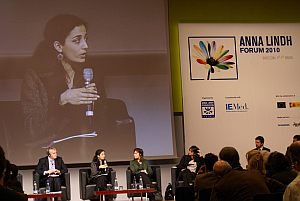
Which conceptions exactly do Europeans have of their immediate neighbors in the Mediterranean and their culture? How is the European Union seen by the inhabitants of neighboring countries in the south? The “Report on EuroMed Intercultural Trends” of the Anna Lindh Foundation provides this information. The results will be presented during a public podium discussion on September 20, 19 hrs, at the Karlsruhe castle (Gartensaal).
Prior to the discussion, a press conference will take place on September 20, 17.30 hrs at the Karlsruhe castle (also Gartensaal). The event will be organized as part of the International Forum of ZAK | Center for Applied Cultural Science and Studium Generale of KIT in cooperation with the German Anna Lindh network and the city of Karlsruhe.
To obtain information on mutual prejudices and clichés, the renowned Gallup Institute, on behalf of the Anna Lindh Foundation, interviewed about 13,000 inhabitants in 13 countries, including Germany, as to their conceptions of the other culture. The results of this report will be published for the first time in Germany on September 20.
Gianluca Solera, network coordinator of the Anna Lindh Foundation, Dr. Sonja Hegasy, Vice Director of the Modern Orient Center, Berlin, and Ayse Özbabacan from the Office for Integration Policy, Stuttgart, and coordinator of the European network “Cities for Local Integration Policies for Migrants“ have been invited as experts for the podium discussion. It will focus on the topics of “Migration and Intercultural Dialog”, “Islam, the West, and Modernity”, and “Differences and Common Features in the System of Values.” These topics are highly up-to-date in view of the ongoing controversial debate of migration and integration.
The Anna Lindh Foundation, named after the murdered Swedish politician, wishes enhance the intercultural dialog between the member states of the European Union and neighboring countries in the Mediterranean. The foundation is established as a network of meanwhile far more than 3000 institutions in 43 member states. The German network that is presently being coordinated by the Goethe Institute and the project office “radius of art” comprises about 120 member institutions. Since 2006, KIT’s ZAK has been part of the network.
The press conference and podium discussion are parts of the 12th network meeting of the Anna Lindh Foundation Germany, which is organized by ZAK in cooperation with the project office “radius of art”, Kiel, and the Goethe Institute, Munich, from September 19 to 21, 2010 in Karlsruhe.
In close partnership with society, KIT develops solutions for urgent challenges – from climate change, energy transition and sustainable use of natural resources to artificial intelligence, sovereignty and an aging population. As The University in the Helmholtz Association, KIT unites scientific excellence from insight to application-driven research under one roof – and is thus in a unique position to drive this transformation. As a University of Excellence, KIT offers its more than 10,000 employees and 22,800 students outstanding opportunities to shape a sustainable and resilient future. KIT – Science for Impact.