
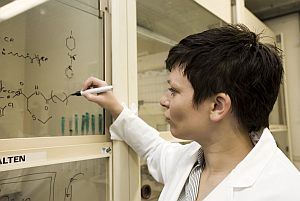
In the subject of natural science and engineering, secondary schools in Baden-Württemberg convey knowledge and relationships of natural sciences and engineering. Karlsruhe Institute of Technology helps them arousing the interest of pupils of classes 5 to 7 in these fields of research. From the 2010/11 winter semester, KIT will train the prospective teachers.
Students can choose the studies course for teaching natural science and engineering as a major or minor subject with unrestricted admittance. They can combine this course with a natural science or mathematics. The application deadline is September 30, 2010.
The studies course is intended to prepare the teachers for conveying the contents of the project-oriented secondary school subject “Natural Science and Engineering” to pupils of classes 5 to 7. The subject covers systems of the observable world, of animated and unanimated nature, and engineering. Studies will focus on the networking, transfer of mass and energy, stability, and the formation and destruction of such systems. The studies course is intended to convey to the teachers new methods to facilitate project-oriented teaching at schools.
Lecturers from four engineering disciplines at KIT are responsible for the technical contents: Civil engineering, geo- and environmental sciences; chemical engineering and process engineering; electrical engineering and information technology; and mechanical engineering. The lecturers cooperate with the Departments of Chemistry and Biosciences and of Physics that are already highly experienced in training teachers. “This combination will give teachers a great chance of designing an ambitious and, at the same time, attractive, project-oriented education in the middle and upper levels of secondary schools,” says Professor Jürgen Becker, who is responsible for teaching at KIT. This holistic approach is also supposed to make more women decide in favor of engineering studies. With a number of courses tailored to the subject of natural science and engineering, “KIT wishes to motivate a maximum number of pupils interested in natural science and engineering to start studies at KIT in the medium term.”
In close partnership with society, KIT develops solutions for urgent challenges – from climate change, energy transition and sustainable use of natural resources to artificial intelligence, sovereignty and an aging population. As The University in the Helmholtz Association, KIT unites scientific excellence from insight to application-driven research under one roof – and is thus in a unique position to drive this transformation. As a University of Excellence, KIT offers its more than 10,000 employees and 22,800 students outstanding opportunities to shape a sustainable and resilient future. KIT – Science for Impact.