
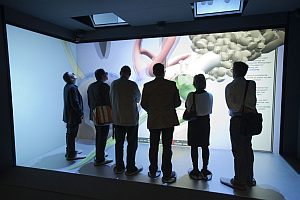
On Thursday, the Lifecycle Engineering Solutions Center (LESC) of Karlsruhe Institute of Technology (KIT) opened a C3 lab. C3 lab stands for “Certified Cyber-Classroom Labs”.
This LESC laboratory is intended to be “an innovative environment, in which a variety of topics can be dealt with”, explained Professor Jivka Ovtcharova, head of the LESC, when the lab was opened today. It is the idea of the C3 lab to arouse the interest of schools and universities in three-dimensional presentations of complex issues of science and engineering. At the laboratory, young people will have the opportunity to test and apply three-dimensionality. “Phenomena that could not be reproduced and were difficult to explain so far can now be presented, a variety of issues in various fields are better understood, when they are visualized”, explained Ovtcharova.
The Cyber-ClassroomTM was developed by the company of VISENSO. It is based on an industrial visualization and virtual reality technology used by development engineers in automotive industry, aircraft and space technology, and mechanical engineering to generate interactive 3D models to simulate, for instance, crashes, the flow behavior, or architectures. Engineers, educationalists, mathematicians, and physicians were involved in the development of the Cyber-ClassroomTM. Numerous three-dimensional learning modules are made available. Among them are the ear, blood circulation, or the skull in the field of biology, molecular dynamics or magnetism in the field of physics, flow mechanics, statics, or mechatronics in the field of engineering, straight lines, planes, or cone sections in the field of mathematics, muscle contraction or biomechanics in the field of sports, or DNA structures and protein databases in the field of chemistry.
To meet the varying demands of schools and universities, the LESC offers two types of the Cyber-ClassroomTM. Both are equipped with open interfaces for the simple exchange of data.
VISENSO GmbH, Stuttgart, is one of the leading suppliers of visualization and virtual reality software as well as of complete solutions (software and hardware). The enterprise is developing tools for the generation of interactive worlds. A successful classroom pilot project funded by the PE foundation was conducted at the Thomas-Strittmatter-Gymnasium, St. Georgen.
In close partnership with society, KIT develops solutions for urgent challenges – from climate change, energy transition and sustainable use of natural resources to artificial intelligence, sovereignty and an aging population. As The University in the Helmholtz Association, KIT unites scientific excellence from insight to application-driven research under one roof – and is thus in a unique position to drive this transformation. As a University of Excellence, KIT offers its more than 10,000 employees and 22,800 students outstanding opportunities to shape a sustainable and resilient future. KIT – Science for Impact.