
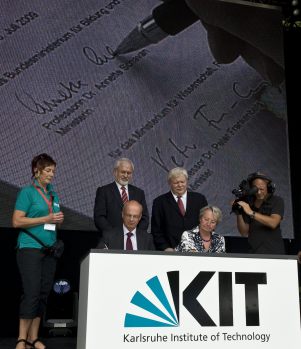
In addition to the KIT Act, the Federal Minister of Education and Research, Annette Schavan, and the Baden-Württemberg State Minister of Science, Research, and Art, Peter Frankenberg, signed the KIT Administrative Agreement on Thursday, July 30, 2009. This document outlines the fundamentals for the further development of the KIT.
The Karlsruhe Institute of Technology (KIT) represents the merger of the Universität Karlsruhe funded by the state of Baden-Württemberg and the large-scale research institution of Forschungszentrum Karlsruhe financed from federal funds. Practical implementation of this merger requires a KIT Act which was adopted by the Baden-Württemberg parliament on July 8 and an Administrative Agreement to be signed by the Federal Republic of Germany and the state of Baden-Württemberg. For the KIT Act, click:
This document outlines details of the further development of the KIT, including its increase in responsibility and the overcoming of rigid structures. For example, the KIT is planned to be assigned the authority to award construction contracts. In addition, it is planned to take measures to enhance KIT’s competitiveness in attracting the best experts. Moreover, KIT’s capacity to act rapidly when participating in companies and research institutions as well as when founding subsidiaries in Germany and abroad shall be developed.
The Administrative Agreement was signed by both ministers in the presence of several thousands of KIT employees and students on July 30, 2009, 14.30 hrs. The joint press release of the Federal Ministry of Education and Research and the Ministry of Science, Research, and Art of Baden-Württemberg dated July 30, 2009 can be found under:
In close partnership with society, KIT develops solutions for urgent challenges – from climate change, energy transition and sustainable use of natural resources to artificial intelligence, sovereignty and an aging population. As The University in the Helmholtz Association, KIT unites scientific excellence from insight to application-driven research under one roof – and is thus in a unique position to drive this transformation. As a University of Excellence, KIT offers its more than 10,000 employees and 22,800 students outstanding opportunities to shape a sustainable and resilient future. KIT – Science for Impact.