The Startup Boom Is Home-grown
Germany is currently struggling with a subdued economic situation. So, a look at the number of newly established companies is surprising: 2025 saw over 3500 new startups – more than in any year before. Despite inflation, rising interest rates, and global uncertainties.
This trend shows that founders thrive not only when the economy is good. Those who start new businesses are motivated by the desire to solve problems, make an impact, and transfer knowledge to practice. The fact that this courage is presently growing underscores the dynamics of Germany as a location of industry and of the places where such ideas flourish particularly well.
Startups Are Firmly Established at KIT
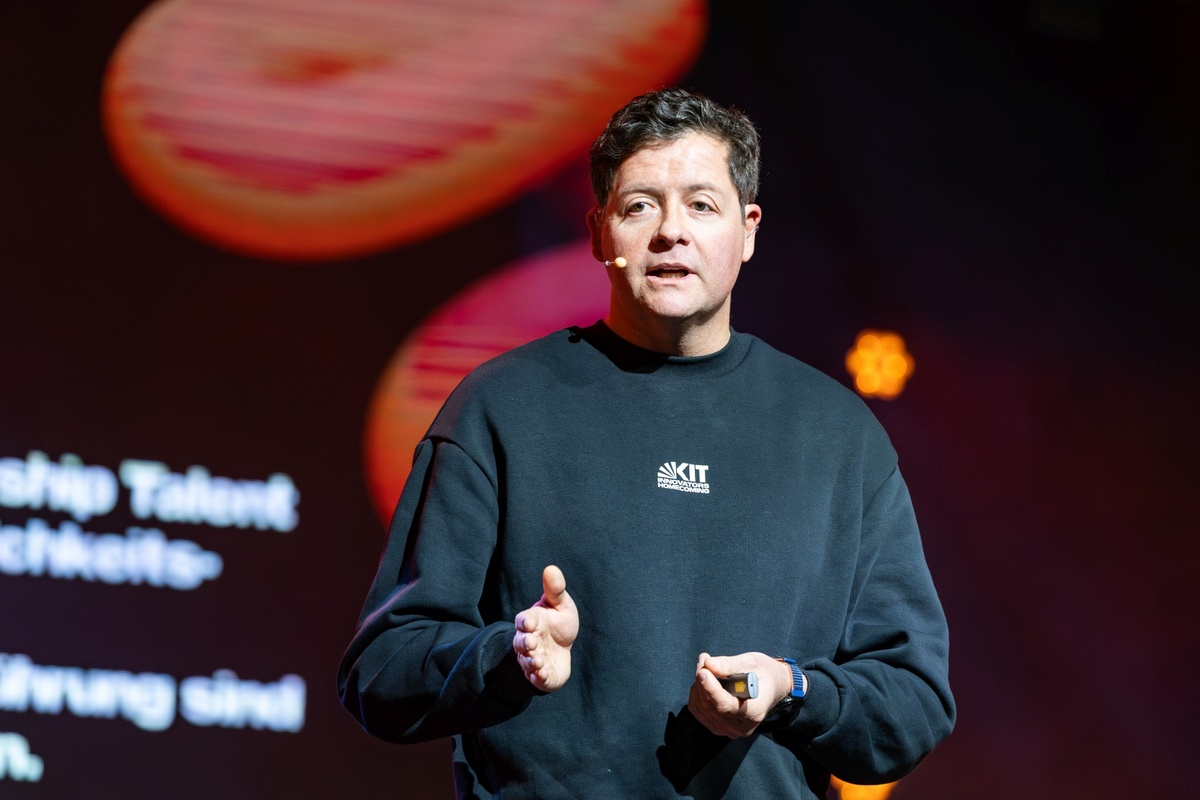
For years, Karlsruhe Institute of Technology (KIT) has been among the German universities spawning a particularly large number of technology-oriented startups. The university developed from a mere place of research into a vibrant environment for startups. “During the past ten years, more than 500 spinoffs have emerged from KIT,” says Thomas Neumann, Head of the KIT-Gründerschmiede (Founders Forge). Every year, more than 50 teams decide to start a business of their own, with the trend increasing.
This does not happen by coincidence. The development is based on a research-oriented infrastructure, access to high-tech labs, early contacts with industry and business stakeholders, and a closely knit network focused on founders and knowledge transfer issues. The KIT-Gründerschmiede combines science with entrepreneurship and supports startup teams exactly at the point where many get stuck: The move from the lab to practice. “It is not our job to start new businesses, but to help and support people with this endeavor,” Neumann says.

Issue 01/2026 of the lookKIT research magazine covers transfer from research to practice.
To the magazineTrust and Space to Take Risks
An example is Dr. Iris Schwenk. She studied physics at KIT and founded the HQS Quantum Simulations startup in 2017, together with three members of her working group. “As fundamental researchers, we didn’t want to watch the action from the sidelines, but to be on the scene when the quantum computer actually goes live,” Schwenk says.
It was not so much about starting with a perfect business idea, but rather having an environment that permitted experimenting, dialog with other founders, and the launch of initial industry projects with players, such as BASF and Bosch. Schwenk sees KIT’s structure as a main factor for the successful establishment of her deep-tech business. She emphasizes that the infrastructure and the support provided by the KIT-Gründerschmiede create trust and give entrepreneurs the space they need to take risks. Today, after a good eight years have passed, the HQS staff numbers more than 40 employees working on an office area of about 800 square meters in Karlsruhe.
The original focus on pure quantum computing applications has shifted in the meantime. “We found that we can solve problems in industry even without a quantum computer,” Schwenk explains. Based on their work on quantum computers, the researchers developed quantum-inspired software that can be run on classical computers and is suited for applications in chemistry, pharmaceutical industry, and materials science.
Opening up Suitable Paths
“It takes more than just a good idea to turn pure research into a product or company,” Neumann says. For an idea to find its way from university to business, it needs a roadmap, expert advice, and favorable conditions. Some ideas lead to startups, others to collaborations with companies or new fields of application. At the KIT-Gründerschmiede, teams learn to classify their startup ideas, identify strengths, and openly address gaps. ”For us, support does not mean dictating everything, but opening up suitable paths,” Neumann points out.
Activities of the KIT-Gründerschmiede are no longer limited to Karlsruhe. It is part of the regional DeepTechHub and an active member of the NXTGN Startup Factory, a cooperation of universities, research institutions, and partners from industry and business aimed at taking technology-driven ideas to market faster. The platform was created as a result of the Startup Factories competition under the exist program launched by the federal government and connects stakeholders from academia, industry, and startups. This broadens the environment in which startups can emerge and grow.
Comprehensive Support
The figures, structures, and experiences clearly show why startups at KIT are not a matter of chance. Research, transfer, and entrepreneurship are intertwined here. Many companies remain professionally connected or get involved as mentors themselves. “We are in contact with working groups and also write research proposals together with researchers from KIT,” Schwenk says. This creates a cycle in which know-how flows back and innovative ideas grow.
When research, infrastructure, and support meet, new opportunities open up, even if external framework conditions are difficult. Thomas Neumann considers this to be the core of the model: “We are not the only wheel in the system, but part of a bigger ecosystem that will only work when all wheels interlock.”
Martin Grolms, March 24, 2026
Translated by Dipl.-Übers. Maike Schröder