
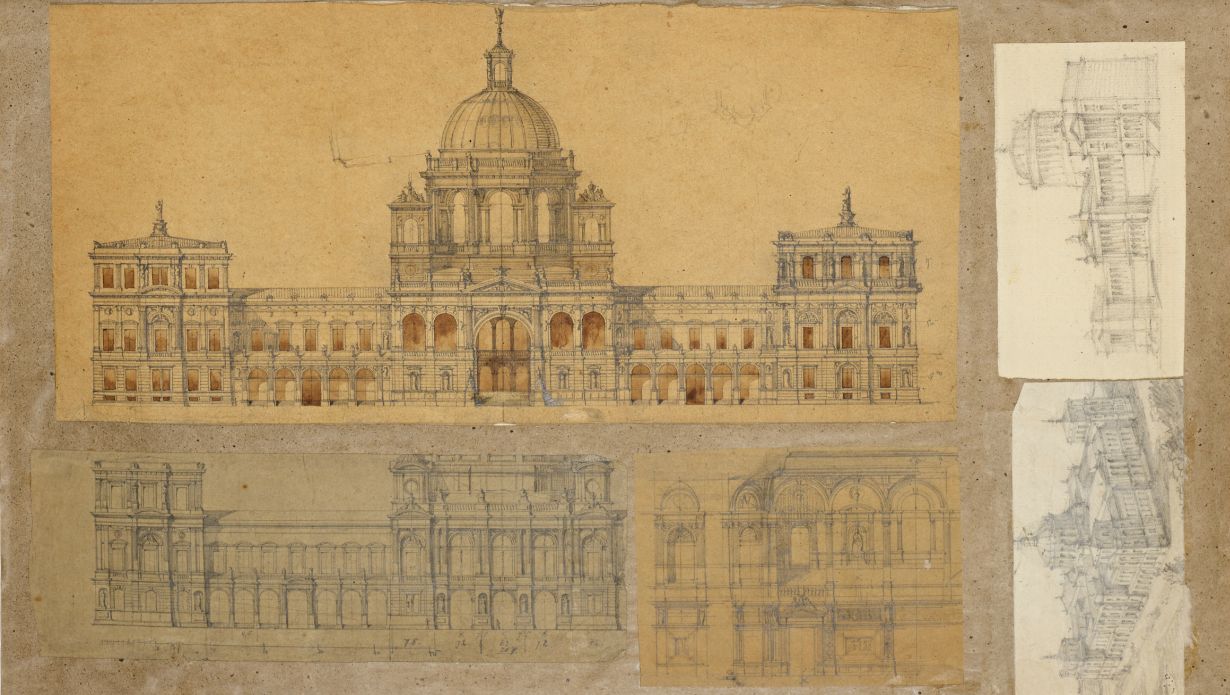
Karlsruhe Institute of Technology (KIT) has acquired an artifact that has great value for the history of architecture: a volume of drawings by Adolf Weinbrenner, the grand-nephew of the classicist architect and building director of the Grand Duchy of Baden. Being a precious document on the history of architectural education in the 19th century, it constitutes an important addition to the collection of KIT’s Archive for Architecture and Civil Engineering (saai).
On its 161 pages, this scrapbook contains 491 individual drawings, mostly pencil or ink sketches, many of them embellished with watercolors and gouache colors. It still has its original half-calf binding and, with its 56 x 34.5 centimeters, exceeds the typical large folio size. “The scrapbook entitled ‘Studien & Pausen. Entwürfe, Aufnahmen von Ad. Weinbrenner 1856–1900‘ (Studies & Traces. Drafts and Sketches by Ad. Weinbrenner 1856-1900’), in which presumably Weinbrenner himself mounted a comprehensive set of particularly expressive and appealing drawings of his own, is a valuable addition to the existing collection of Adolf Weinbrenner’s works owned by the saai,” says saai’s Martin Kunz. “We are delighted that we succeeded in acquiring this comprehensive scrapbook at the suggestion of the Friedrich-Weinbrenner-Gesellschaft, an association dedicated to his work. Our special thanks go to the association’s president, whose expert report on the scrapbook helped us to obtain funding from the Stiftung Kulturgut Baden-Württemberg (Baden-Württemberg cultural heritage foundation).”
Insight into the Work of Adolf Weinbrenner
The drawings give a compact overview of Adolf Weinbrenner’s complete works and demonstrate his great versatility. The collection begins with early studies created under various professors, including a draft from 1853 of the colonnades for the Baden-Baden promenade. This is followed by drafts of railroad station buildings and their design structures as well as a drawing of the church “St. Maria Unsere Liebe Frau vom Karmel” in Bräunlingen, created between 1881 and 1883. The collection also shows his restoration projects, such as the conversion of the Altes Amtshaus building and the Konzil building in Constance as well as the renovation of Heiligenberg Castle and Salem Minster. Besides these buildings, which were actually realized, his contribution to the competition for the Reichstag in Berlin from 1882 is also included in the scrapbook. These architectural works are complemented by drafts for a sailing boat, furniture, and the Great Official Seal of the Rector of Karlsruhe Technical University, one of KIT’s predecessor institutions.
“The drawings are of a consistently high quality, showing his virtuoso artistic and technical skills and giving evidence of his exceptional precision and attention to detail, even in small-scale drawings,” says Kunz. “One particularly noteworthy aspect here is the deliberate synthesis between architecture and engineering, which follows the polytechnic concept and represents a characteristic of the Karlsruhe School in the 19th century. This volume is an important addition to the collections of the Karlsruhe School at saai, whose origins date back to the works of Friedrich Weinbrenner.”
About Adolf Weinbrenner
Adolf Weinbrenner (1836-1921) was a grand-nephew of Friedrich Weinbrenner (1766-1826), the classicist architect and building director of the Grand Duchy of Baden. He studied architecture in the classes of Heinrich Hübsch and Friedrich Eisenlohr at the “Polytechnikum” in Karlsruhe, today’s KIT. After graduating, he joined the railroad construction administration, where he worked at the interface between architecture and technical infrastructure. He then undertook study trips to Italy, France, and Belgium. After his return, he became building inspector at the princely court in Donaueschingen before he was appointed professor in 1880 at the Polytechnic School in Karlsruhe (Technical University as of 1885), which had emerged from his grand-uncle’s building school. Before retiring in 1911 due to an eye condition, he was appointed Geheimer Oberbaurat (chief building privy councilor).