
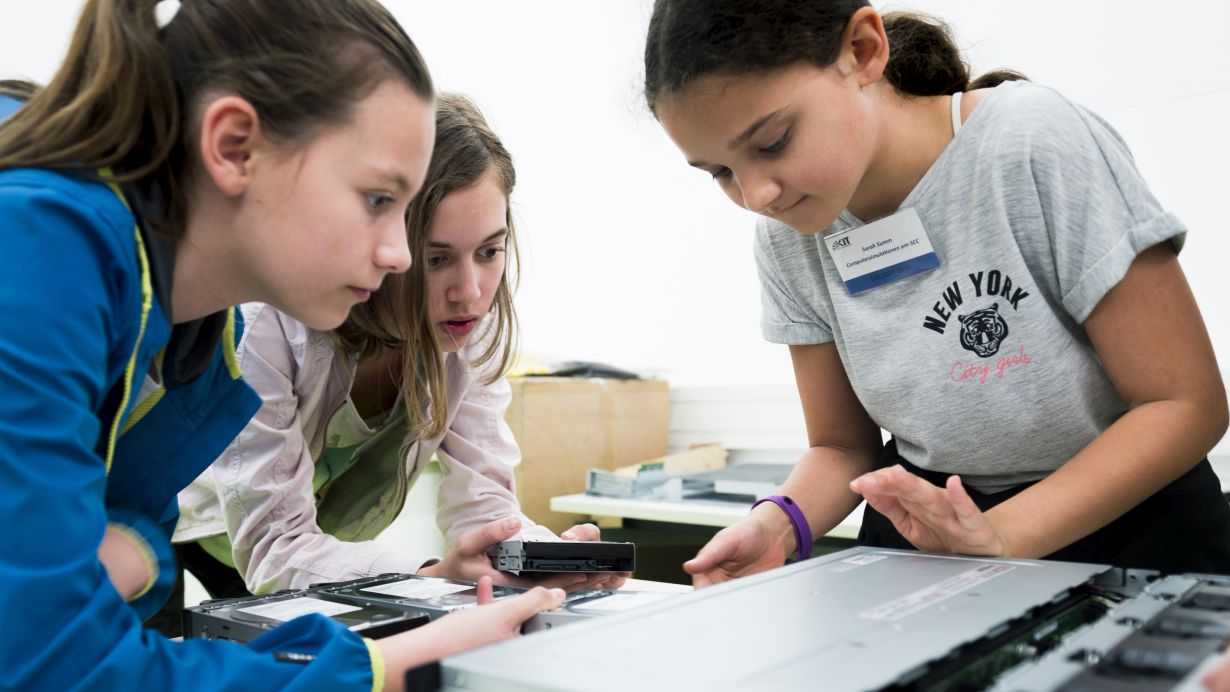
Why does your smartphone do what you want it to do? What is the work of a physics laboratory assistant, transport engineer, or technical product designer? What are the smallest particles in the universe? Answers and information on the corresponding studies and vocational training programs will be given to girls on the Girls’ Day 2021 on Thursday, April 22, 2021, at Karlsruhe Institute of Technology (KIT). Girls from the 5th year of all types of schools will then have the opportunity to attend a number of presentations and workshops and learn more about the fields of work and jobs in STEM subjects at KIT.
[…]
This year’s Girls’ Day at KIT will take place online on “Zoom.”
Further information on the program, registration, and services can be found at https://www.chg.kit.edu/1279.php (in German).
New Video Series “WIT // Women in IT“
What is informatics, how do studies proceed, and how do women feel in this “men’s world”? The KIT Department of Informatics and ZML – Center for Technology-Enhanced Learning of KIT provide answers to these and other questions: In the video series “WIT // Women in IT,“ five women talk about why they are fascinated of computer science, their personal experiences gained during studies, and how they are connected to IT today.
For the video series “WIT // Women in IT“: https://www.informatik.kit.edu/english/11930.php
More Information:
Video “KIT, the Research University in the Helmholtz Association.” https://www.youtube.com/watch?v=7vturWXHcL8
In close partnership with society, KIT develops solutions for urgent challenges – from climate change, energy transition and sustainable use of natural resources to artificial intelligence, sovereignty and an aging population. As The University in the Helmholtz Association, KIT unites scientific excellence from insight to application-driven research under one roof – and is thus in a unique position to drive this transformation. As a University of Excellence, KIT offers its more than 10,000 employees and 22,800 students outstanding opportunities to shape a sustainable and resilient future. KIT – Science for Impact.