
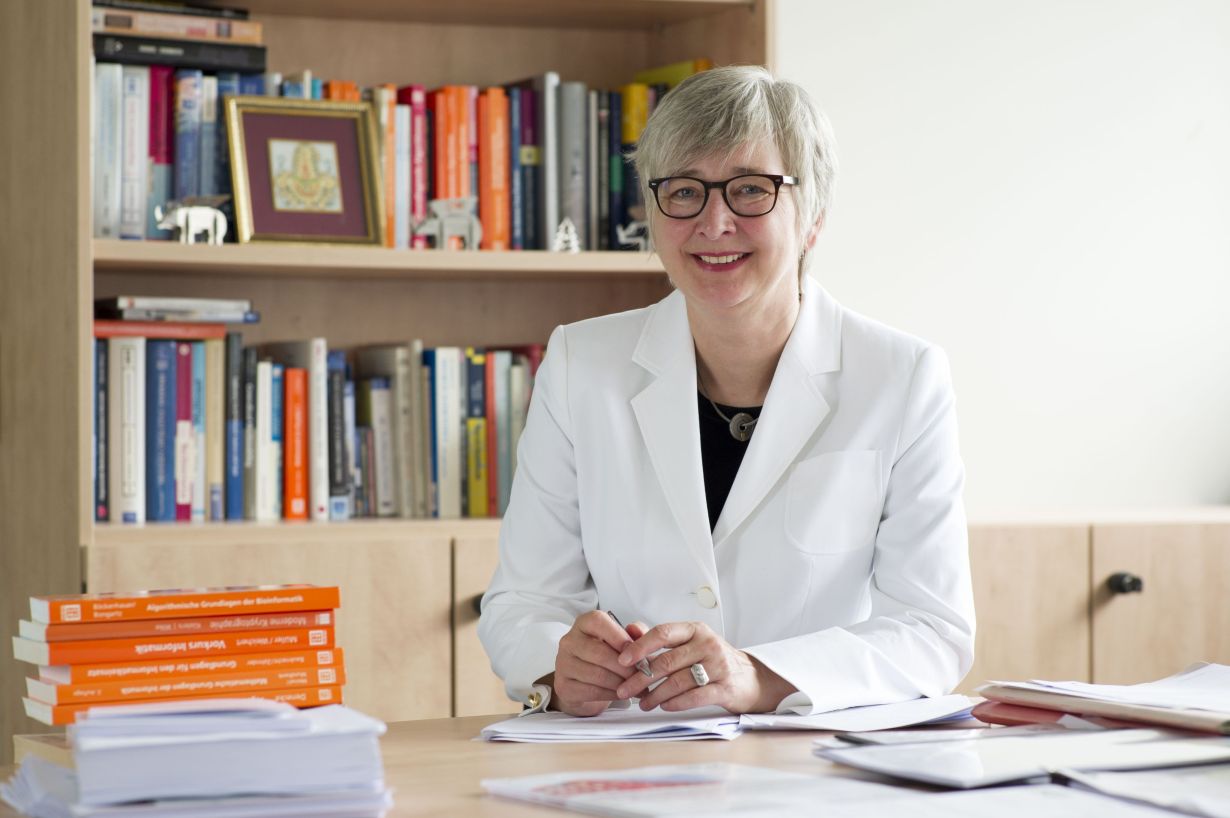
Computer scientist Dorothea Wagner, who conducts research and teaches at Karlsruhe Institute of Technology (KIT), will chair the Council of Science and Humanities, Germany’s most important advisory body in research policy. After her predecessor, agricultural economist Martina Brockmeier, and engineering scientist Dagmar Schipanski, Dorothea Wagner, professor and Head of KIT’s Institute of Theoretical Informatics, is the third woman in this post.
The Council of Science and Humanities advises the federation and the states in matters of work content and structural further development of the university system as well as state funding of research institutions. “I am convinced that Professor Dorothea Wagner is the right person to largely contribute to strengthening science in Germany,” says the President of KIT, Professor Holger Hanselka. While working at KIT, she mainly conducted research into algorithms. “Her work in the area of computer science is future-oriented on both the national and international level.” Moreover, Dorothea Wagner is an acknowledged expert of the German science system. She gained vast experience as Vice President of DFG, Member of the Council of Science and Humanities, and in a number of bodies of scientific institutions. “I cordially congratulate Dorothea Wagner on her unanimous election as new Chairperson of the Council of Science and Humanities,” Hanselka emphasizes.
“The Council of Science and Humanities plays an outstanding role in shaping the German science landscape in its entity. In it, KIT has an unparalleled double function as university of excellence and member of the Helmholtz Association. In many respects, we are therefore pleased about the election of Dorothea Wagner, who is an excellent scientist of KIT and knows both the perspective of a university and that of a large-scale research institution,” adds Professor Oliver Kraft, KIT Vice-President for Research.
“I am looking forward to taking over this office, even more so as this is the right time to chair the Council when judging from my discipline. Many of the upcoming and pressing issues are related to computer science. Within the next years, we will increasingly deal with how science changes in the digitalization era. This will be the focus of my work as Chairperson of the Council of Science and Humanities,” Professor Dorothea Wagner says.
In the Scientific Commission of the Council of Science and Humanities, whose Vice-Chairperson Dorothea Wagner has been so far, Peter Gumbsch, Professor for Mechanics of Materials at KIT, was confirmed in office as chairperson.
More about the KIT Information · Systems · Technologies Center: http://www.kcist.kit.edu
In close partnership with society, KIT develops solutions for urgent challenges – from climate change, energy transition and sustainable use of natural resources to artificial intelligence, sovereignty and an aging population. As The University in the Helmholtz Association, KIT unites scientific excellence from insight to application-driven research under one roof – and is thus in a unique position to drive this transformation. As a University of Excellence, KIT offers its more than 10,000 employees and 22,800 students outstanding opportunities to shape a sustainable and resilient future. KIT – Science for Impact.