
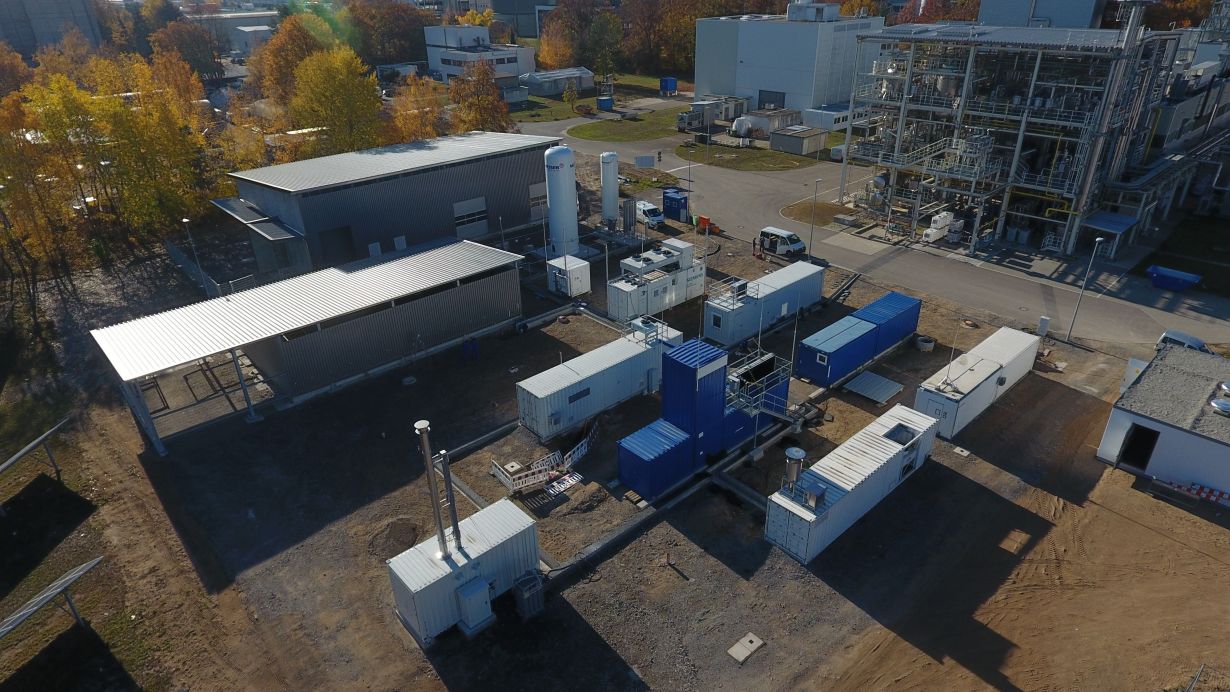
Aviation is energy-intensive. Air traffic is increasing constantly, with negative impacts on the world’s climate. Now, Karlsruhe Institute of Technology (KIT) and Ineratec, a spinoff of KIT, are testing, together with other partners from industry and research, the production of synthetic climate-neutral fuels for aviation, heavy-duty traffic, and ship traffic.
“We urgently need CO2-free mobility,” says Professor Roland Dittmeyer, Head of the Institute for Micro Process Engineering (IMVT) of KIT. In Germany, about one fifth of the climate-damaging emissions are caused by traffic. This problem might be solved by electric drives, if they are supplied with CO2-free electricity. But: electric mobility is hardly suited for use in aviation or ship traffic. The solution: synthetic fuels based on the greenhouse gas CO2 and renewable electricity. It is planned to extract CO2 from ambient air using a direct air capture system by Climeworks. The electrolysis technology to generate hydrogen from water with the help of electricity is made by Siemens.
Within the PowerFuel project at KIT, a pilot plant developed by Ineratec is applied to convert CO2 into synthesis gas with the help of hydrogen. “The synthesis gas is then used to produce liquid fuel in a reactor,” says the Managing Director of Ineratec Tim Böltken. By means of this power-to-liquid process, nearly climate-neutral fuel can be produced in an economically efficient way. Energy supply from renewable sources is subject to natural fluctuation. By the use of compact chemical reactors developed by Ineratec, an optimum response to these fluctuations is found and power that so far remained unused can be stored in liquid fuel. “Compared to conventional gasoline, diesel, or kerosene, our synthetic fuels have far better combustion properties,” Böltken says. The quality of synthetic fuels and the use in different transportation sectors are studied and assessed by the German Aerospace Center (DLR) and Aviation Fuel Projects Consulting. In the pilot phase, the plant is to produce 200 to 300 l fuel per day.
Parallel to the operation of the plant complex, Siemens, Bauhaus Luftfahrt, and TU Hamburg will make energy systems analyses supported by simulation based on electricity market models. Analysis shall also cover the question how synthetically produced fuels can be commercialized.
The project is funded by the Federal Ministry for Economic Affairs and Energy.
More about the KIT Energy Center: http://www.energy.kit.edu
In close partnership with society, KIT develops solutions for urgent challenges – from climate change, energy transition and sustainable use of natural resources to artificial intelligence, sovereignty and an aging population. As The University in the Helmholtz Association, KIT unites scientific excellence from insight to application-driven research under one roof – and is thus in a unique position to drive this transformation. As a University of Excellence, KIT offers its more than 10,000 employees and 22,800 students outstanding opportunities to shape a sustainable and resilient future. KIT – Science for Impact.