
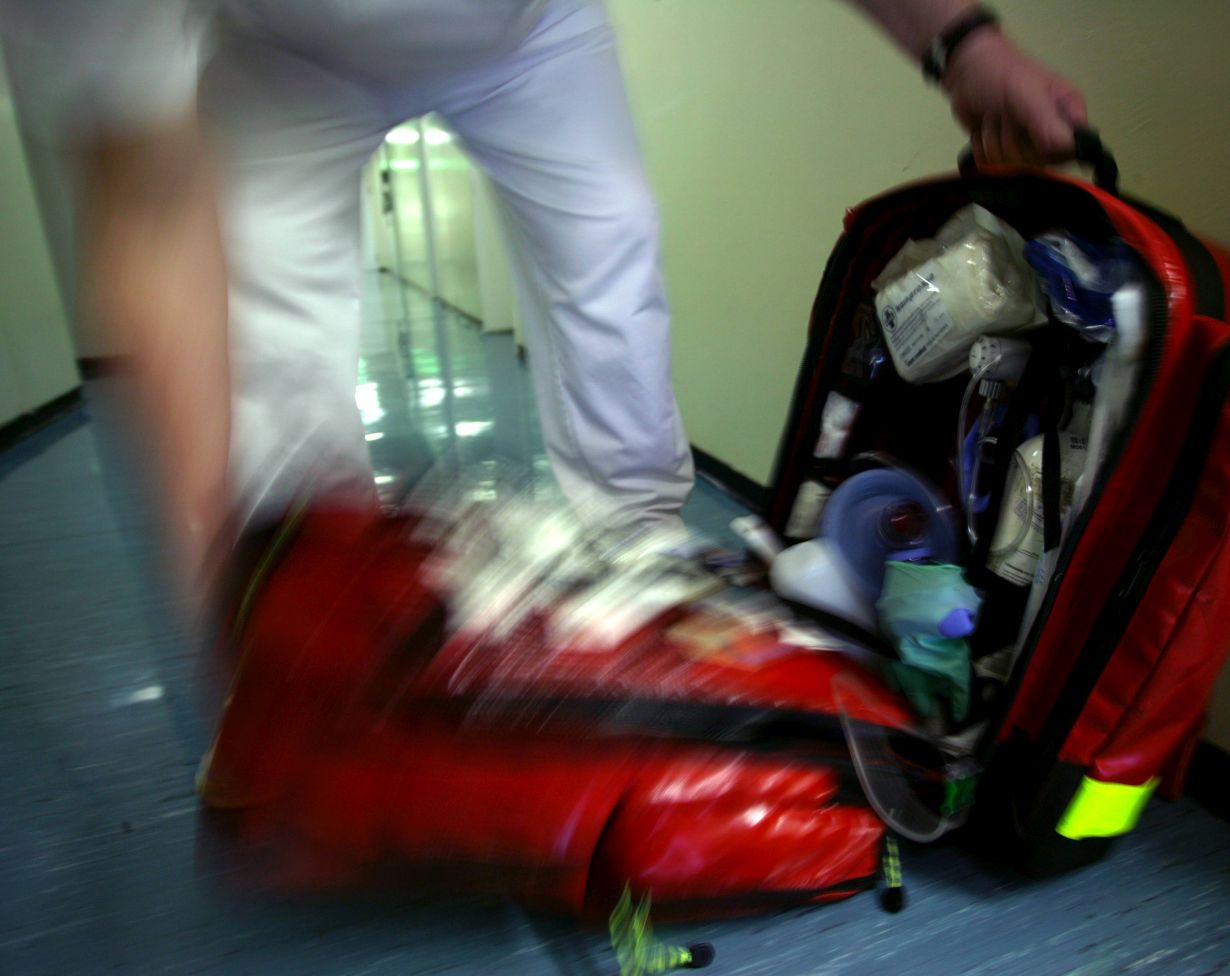
Every day, about 250 people in Germany die from heart attacks. Rapid and appropriate first aid can considerably increase the chances of survival of a patient and even more so, if physicians and paramedics would be given relevant information prior to their arrival on the emergency site. Within the RAMSES project, a consortium project led by Karlsruhe Institute of Technology (KIT) and funded by the EU Initiative EIT Health, an appropriate technical solution, called EmergencyEye, is being developed. The system enables emergency control centers to provide first aiders with the information required by video via their smartphones.
Less than 10% of the people affected by a cardiac attack survive reanimation. Between 75,000 and 100,000 people die from the ensuing complications every year. Digitization of the healthcare sector now opens up opportunities to significantly reduce these figures that have been stable for years, but: “In the healthcare sector, Germany still is in the IT stone age,” says the expert for telemedicine, Professor Wilhelm Stork, Head of the Microsystem Technology Group of the Institute for Information Processing Technology (ITIV) of KIT and consortium leader of RAMSES.
Within the RAMSES (Remote Access to Medical Information on Smartphones during Emergencies and Health Crisis) project that started early this year, a technical solution is to be developed within a period of one year. A central element is the EmergencyEye remote access module, with which the project partner and startup Corevas won the first round of the 2017 Head Start Program of the European Institute of Innovation and Technology (EIT). ITIV studies ways of how the planner can open a feedback channel via the smartphone of the first aider without the smartphone considering this an unauthorized access and preventing it.
Hackathon: Ideas for Further Development
Ideas are to be generated by the “EmergencyEye-Hackathon am Ring”: Students are invited to develop solutions for emergency management by remote access to smartphones on February 16 – 18, 2018 at the Nürburgring. The program also includes keynotes and events on e.g. design thinking or business modeling.
More information and registration: https://hackathonamring.jimdo.com/
The European Institute of Innovation and Technology (EIT), an initiative of the EU established in 2008, connects European cutting-edge research and companies to push solutions for central future issues and to strengthen competitiveness of European industry. The EIT Health Consortium initiated in 2014 is one of the biggest health initiatives worldwide. Its objective is to sustainably improve healthcare.
http://eit.europa.eu/eit-community/eit-health
In close partnership with society, KIT develops solutions for urgent challenges – from climate change, energy transition and sustainable use of natural resources to artificial intelligence, sovereignty and an aging population. As The University in the Helmholtz Association, KIT unites scientific excellence from insight to application-driven research under one roof – and is thus in a unique position to drive this transformation. As a University of Excellence, KIT offers its more than 10,000 employees and 22,800 students outstanding opportunities to shape a sustainable and resilient future. KIT – Science for Impact.