
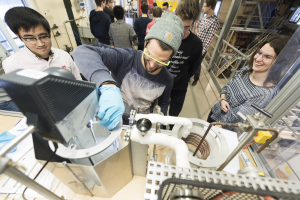
KIT’s “Research-based Education” program is funded by the Federal Republic of Germany and intended to implement this concept on a broad level. Under this program, Karlsruhe Institute of Technology (KIT) integrates students into scientific projects at an early stage and education quality is improved sustainably. Partial projects and first results will now be presented on the Campus Day “LehreForschung” on Friday, October 14, 2016, 9 am at the Tulla-Hörsaal on Campus South of KIT (in German only).
“As an institution that is strong in research, KIT wants to offer and extend research-based education,” the Vice President for Higher Education and Academic Affairs of KIT, Professor Alexander Wanner, says. “Under the Research-based Education program, we develop and implement new forms of education based on latest research results and convey interdisciplinary thinking and innovation-oriented working styles. “The Campus Day “LehreForschung” will present several partial projects and their results: The service office “problem-oriented learning” in informatics, studios for architectonic thinking, and technology didactics in mechanical engineering.
The Federal Republic of Germany funds the “Research-based Education” project at KIT under the Program for More Quality in Teaching. In the first funding phase that started in 2012, about EUR 8 million were spent for the project. In the second funding phase starting this year, KIT will receive about EUR 10 million for the follow-up project “Research-based Education PLUS” that will have a duration of four years. Many of the partial projects implemented successfully so far have been integrated into the curricula in the meantime. The second phase is now aimed at transferring the findings to other institutes and departments of KIT.
[...]
An interview of Professor Alexander Wanner on “Research-based education” and examples of partial projects can be found in the students magazine clicKIT (in German only):
http://www.clickit-magazin.de/wir-scheuen-das-risiko-nicht/
[...]
In close partnership with society, KIT develops solutions for urgent challenges – from climate change, energy transition and sustainable use of natural resources to artificial intelligence, sovereignty and an aging population. As The University in the Helmholtz Association, KIT unites scientific excellence from insight to application-driven research under one roof – and is thus in a unique position to drive this transformation. As a University of Excellence, KIT offers its more than 10,000 employees and 22,800 students outstanding opportunities to shape a sustainable and resilient future. KIT – Science for Impact.