
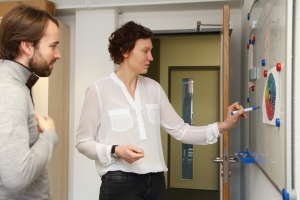
“Considering the short-term costs of software development and operation only is not sufficient,” Dr. Stefanie Betz of the KIT Institute of Applied Informatics and Formal Description Methods (AIFB) explains. “Many companies have realized this and increasingly focus on sustainability. This also contributes to long-term business success.”
In her post-doctoral lecture qualification thesis, Stefanie Betz analyzes this development and deals with “Sustainability-aware Software System Engineering”, which means that software is developed taking into account sustainability, i.e. ecological, social, and economic aspects.
Stefanie Betz analyzes the complete lifecycle of software systems and all associated business processes, such as product sales and systems maintenance. “All these factors have to be adapted to each other for the complete product meeting sustainability requirements,” Stefanie Betz says.
Based on the analysis of business processes, the scientist then defines sustainability criteria and develops various scenarios to determine time expenditure, energy consumption, and costs of various solutions. Finally, a decision model results, by means of which the complete development process and lifecycle of software, from planning to design, to implementation, to check, to maintenance, can be made sustainable. In this way, the consumption of energy and resources and work expenditure can be reduced.
The state of Baden-Württemberg has launched the Margarete von Wrangell post-doctoral lecture qualification program to support outstanding female scientists on their way to professorship. As a rule, funding is scheduled for a duration of up to five years. The Baden-Württemberg Ministry of Science, Research, and the Arts (MWK) funds the position of the female scientist for three years. Then, funding is continued by the respective university for a period of two years. In addition to their research work, the scientists selected for the funding program are to lecture four hours per week. In the recent round of the competition, ten female scientists were selected for funding.
In close partnership with society, KIT develops solutions for urgent challenges – from climate change, energy transition and sustainable use of natural resources to artificial intelligence, sovereignty and an aging population. As The University in the Helmholtz Association, KIT unites scientific excellence from insight to application-driven research under one roof – and is thus in a unique position to drive this transformation. As a University of Excellence, KIT offers its more than 10,000 employees and 22,800 students outstanding opportunities to shape a sustainable and resilient future. KIT – Science for Impact.