
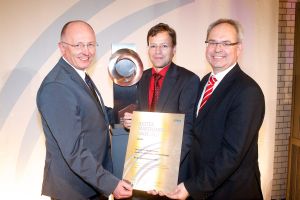
The KIT Department of Mechanical Engineering won the first prize in the Germany-wide university competition launched by the German Engineering Association (VDMA, Verband Deutscher Maschinen- und Anlagenbau e.V.). It now bears the title “Bestes Maschinenhaus 2013” (best machine house 2013). The prize in the amount of EUR 100,000 granted by VDMA is to acknowledge a convincing education concept that enhances the success of studies and ensures quality in education. For the final, six German departments and faculties of mechanical and electrical engineering were nominated. The prize ceremony took place yesterday evening, November 20, 2013, under the auspices of Federal Minister of Education Johanna Wanka in Berlin.
“The title “best machine house” is a great honor for the Department of Mechanical Engineering. It reflects the quality of education in mechanical engineering at KIT. The Department has developed and implemented excellent methods to ensure quality and success of our students,” KIT President Professor Holger Hanselka says.
“I am highly pleased that the KIT Department of Mechanical Engineering won this demanding competition. This shows that mechanical engineering in Karlsruhe attaches high priority to the education level as well as to the success of studies,” emphasizes Professor Alexander Wanner, KIT Vice President for Higher Education and Academic Affairs.
Dr. Reinhold Festge, President of VDMA, handed the prize over to the Dean of the Department of Mechanical Engineering, Professor Jürgen Fleischer, and the Studies Dean, Professor Carsten Proppe. “I am very proud of our department. Thanks to our perfect teamwork, we succeeded in convincing the jury with our concept for quality assurance in education,” Jürgen Fleischer says.
In the opinion of the VDMA, the education concept of KIT is designed to follow the rules of quality management and contains a well-coordinated mix of measures. The needs of students and networked learning play an important role. An example is the MINT Kolleg Baden-Württemberg (course of lectures in mathematics, informatics, natural sciences, and engineering) that ensures individual study speeds. When students join a minimum number of hours per week in these lecture courses, they can extend their standard period of study and, hence, decelerate their studies. Together with the department, the KIT Quality Management regularly checks the effectiveness of the measures taken. In this way, a high quality of education is ensured sustainably in the long term, according to the VDMA. KIT’s education concept convinced the jury of 14 representatives of university institutions, companies, and associations. For the final, six faculties and departments of mechanical and electrical engineering had been nominated of a total of 23 applicants. Apart from KIT, these were the Technical University of Darmstadt, Stuttgart University, the University Bonn-Rhein-Sieg, the University of Offenburg, and FH Cologne/Campus Gummersbach. The competition is aimed at increasing the success of studies and reducing the drop-out rate in mechanical and electrical engineering. The prize money in the amount of EUR 100,000 will be used for the implementation of concrete measures at the Department.
In close partnership with society, KIT develops solutions for urgent challenges – from climate change, energy transition and sustainable use of natural resources to artificial intelligence, sovereignty and an aging population. As The University in the Helmholtz Association, KIT unites scientific excellence from insight to application-driven research under one roof – and is thus in a unique position to drive this transformation. As a University of Excellence, KIT offers its more than 10,000 employees and 22,800 students outstanding opportunities to shape a sustainable and resilient future. KIT – Science for Impact.