
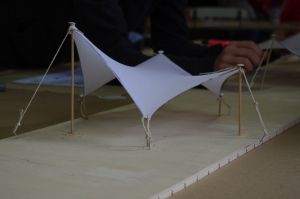
An emergency shelter must be rapidly available, inexpensive, easy to transport, and uncomplicated to set up. This is why the tent is the first choice in emergency relief. But often, the temporary solution becomes a permanent one that may last for years. The project of students of architecture at KIT was aimed at improving living conditions in such camps. With the hexagonal construction “x-tent.me”, they developed a transition solution between a temporary shelter and a permanent housing.
Students of the Divisions of “Building Lifecycle Management“ and “Structural Design” of the Department of Architecture at KIT analyzed the advantages and drawbacks as well as possibilities of replacing, adapting, and extending tent constructions in a workshop of one week duration. They assumed scenarios of extreme weather situations, such as sudden onsets of winter in Japan or extreme rainfall in Pakistan. In the course of their work, they also considered the framework conditions and standards of international humanitarian aid organizations. Aspects like logistics, costs, individualization, further use and reuse, recycling, and disposal were taken into account in concept development.
The result: A tent of hexagonal layout. Contrary to square or rectangular models, the hexagonal construction requires few planning interventions only to create a functioning assembly of interior and exterior rooms. Individually usable spaces are created, which counteract excessive efficiency and monotony and allow for an adaptation to cultural traditions in the area of use.
In addition, the students developed an innovative, multi-functional transport box, the size of which is adapted to standardized Euro-pallets. These boxes are modular units that contain the basic tent components as well as special devices adapted to various climate conditions. Every box can be turned into a bed. The cavity between the floor and the bed surface may be used as a lockable storage room or filled with leaves or straw for insulation and additional protection against wet and cold.
In 2009, the institutes involved already were successful in the students competition “Guerilla Housing – spontaneous living in urban spaces” with their accommodation bin “Roll-it”.
A video documentation on “x-tent.me” is available on KIT’s Youtube channel: www.kit.edu/youtube.
Further information is also given in the current issue of the KIT students magazine ClicKIT at http://www.kit.edu/clickit and on the project website www.x-tent.me.
In close partnership with society, KIT develops solutions for urgent challenges – from climate change, energy transition and sustainable use of natural resources to artificial intelligence, sovereignty and an aging population. As The University in the Helmholtz Association, KIT unites scientific excellence from insight to application-driven research under one roof – and is thus in a unique position to drive this transformation. As a University of Excellence, KIT offers its more than 10,000 employees and 22,800 students outstanding opportunities to shape a sustainable and resilient future. KIT – Science for Impact.