
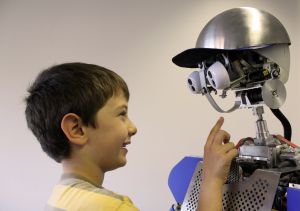
What will the future of robots be like? Will they be used not only at production halls, but also as helpers of man in his private surroundings? Scientists of the KIT Anthropomatics and Robotics Focus study personalized systems tailored to man. On Tuesday, January 17, 2012, 18.30 hrs, they will present their work at the Karlsruhe City Hall under the heading of “Technologien für Menschen“ (Technologies for Man).
The Anthropomatics and Robotics Focus concentrates on future-oriented problems and studies the symbiosis of man and machines: What makes a robot the friend and helper of man? How can intelligent systems be applied effectively by medicine and industry? Research at KIT focuses on machine intelligence, human-centered robotics, multi-modal interaction and communication, robot technologies, and industrial robotics. Computer scientists cooperate with mechanical engineers, electrical engineers, and social scientists to develop systems that improve man’s quality of life.
“KIT im Rathaus“ (KIT at the City Hall) will provide interested persons with exciting insights into this field of research. Here, the public will be able to talk to the scientists and be introduced to ARMAR, the robot. Citizens and in particular pupils are cordially invited to this event. During the reception following the presentations, there will be many opportunities for conversation with the scientists. In parallel, an exhibition will be organized on the upper floor of the City Hall from January 16 to 20, 2012. Admission will be free.
The program:
Welcome Addresses
Heinz Fenrich, Lord Mayor of the city of Karlsruhe
Professor Horst Hippler, President of Karlsruhe Institute of Technology (KIT)
The KIT Anthropomatics and Robotics Focus Presents Itself
Professor Rüdiger Dillmann, Spokesman of the Anthropomatics and Robotics Focus, Institute of Anthropomatics, Humanoids and Intelligence Systems Lab, KIT
Vision and Reality – New Results in Medical Engineering
Professor Georg Bretthauer, Institute of Applied Computer Science / Automation Technology, KIT
Silent Communication
Professor Tanja Schultz, Institute of Anthropomatics, Cognitive Systems Lab, KIT
Extended-range Telepresence: Moving in a Remote Environment!
Professor Uwe D. Hanebeck, Institute of Anthropomatics, Intelligent Sensor-actuator Systems, KIT
Further information: www.zak.kit.edu
In close partnership with society, KIT develops solutions for urgent challenges – from climate change, energy transition and sustainable use of natural resources to artificial intelligence, sovereignty and an aging population. As The University in the Helmholtz Association, KIT unites scientific excellence from insight to application-driven research under one roof – and is thus in a unique position to drive this transformation. As a University of Excellence, KIT offers its more than 10,000 employees and 22,800 students outstanding opportunities to shape a sustainable and resilient future. KIT – Science for Impact.