
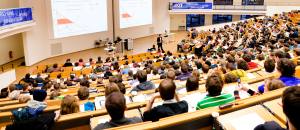
In the current 2012/2013 winter semester, the number of students at Karlsruhe Institute of Technology (KIT) is higher than ever before. Of the currently 23,905 students enrolled, 4,708 are freshmen. 1,307 of them are female, 1,127 come from abroad. KIT has used the funds provided by the state of Baden-Württemberg under the program “Hochschule 2012” to prepare well for the higher number of secondary school graduates.
Compared to the past year, the number of students at KIT increased by another 1,500 to nearly 24,000. The proportion of females is 27 percent (6,422), 16 percent of the students come from abroad (3,859). According to Alexander Wanner, the Chief Higher Education Officer responsible for education at KIT, KIT is prepared well for the growing number of students. “As in previous years, most freshmen started to study engineering, natural sciences, and economics. In these highly popular subjects, KIT created 1,100 additional study places in the past five years.”
The Department of Economics has increased the number of study places in economic engineering by nearly 40% to 555. The Department of Mechanical Engineering has established two new bachelor programs (mechatronics and information technology, materials science and technology) and now offers a total of 820 places. Applicants were also highly interested in the new bachelor program “Science, media, and communication” as well as in the bachelor program of architecture.When pupils leaving secondary school decide to start studies of mathematics, informatics, natural sciences, and engineering, which are considered difficult in general, support is provided by the MINT-Kolleg Baden-Württemberg, a joint facility of KIT and Stuttgart University. The courses are offered to prepare for these studies and also run parallel to them in order to facilitate the transition from the secondary school to university and to reduce the quit rate. Since the start of the MINT-Kolleg one year ago, a total of 2,500 pupils and students have participated in the courses.
According to Alexander Wanner, however, room capacities are completely exhausted now. So far, the state has promised EUR 6.4 million for constructing new and renting existing buildings. Among others, a learning center is being built on Campus South. It is planned to be completed by late 2013 and to accommodate three seminar rooms, a biological laboratory, a chemical laboratory, 90 workplaces, and a lounge for students. “The learning center will certainly ease the demand for more rooms, but this demand will remain high, as the number of students increases,” says Wanner.
More information on the numbers of students:
www.kit.edu/studieren/6407.php
In close partnership with society, KIT develops solutions for urgent challenges – from climate change, energy transition and sustainable use of natural resources to artificial intelligence, sovereignty and an aging population. As The University in the Helmholtz Association, KIT unites scientific excellence from insight to application-driven research under one roof – and is thus in a unique position to drive this transformation. As a University of Excellence, KIT offers its more than 10,000 employees and 22,800 students outstanding opportunities to shape a sustainable and resilient future. KIT – Science for Impact.