
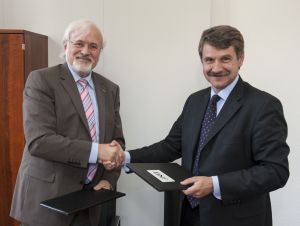
Experts agree that costs of efficient lithium-ion batteries are too high. This applies as much to electric cars as it does to storing solar and wind energy. One major cost factor is the costly production process of lithium-ion batteries. Karlsruhe Institute of Technology (KIT) and the Stuttgart-based M+W Group have now agreed on a development partnership with the aim of massively reducing the use of energy and materials in battery production and, hence, the costs.
Professor Eberhard Umbach, President of KIT, and Jürgen Wild, CEO of M+W Group, signed an agreement a few days ago, which specifies the key points of the future partnership. Cooperation essentially encompasses dry-room technology, resource-efficient plants, and process control systems.
Andreas Gutsch, coordinator of the Competence E project at KIT, sums up: “Cooperation with an internationally renowned factory designer and plant manufacturer will allow for the direct incorporation of our development results in innovative concepts for cell and battery manufacture and their global marketing. We want to further develop industrial processes while keeping a particular eye on costs.”
“The existing practical knowledge of M+W Group as regards the engineering and construction of lithium-ion facilities ideally complements KIT’s excellent expertise in research into battery manufacture,” says M+W Group CEO Jürgen Wild. “Together, we will find new ways of reducing costs in battery production of our customers more quickly.
”So far, energy-intensive processes, such as drying the coated electrodes, cell assembly in the dry room, or cell formation have dominated lithium-ion cell manufacture. The cooperation will contribute to making the entire energy system of cell and battery manufacture more efficient. KIT’s applied research will focus on the energy efficiency of both the facility and the installed processes. At the same time, the proportion of renewable energies in the supply of energy-optimized production will be increased. Gutsch says: “Installing a photovoltaic plant with coupled, stationary energy storage on KIT’s Campus North will allow for the implementation of power supply based on renewable energy and, hence, “green” cell production.”
“M+W Group links the objective of achieving considerable cost reductions in plants to manufacture lithium-ion batteries with the most stringent high-quality manufacture requirements. In doing so, we are able to use the experience from other high-tech industries, such as the semiconductor or photovoltaic sectors, and achieve innovative solutions together with KIT,” says Dr. Rudolf Simon, Technology Manager Automotive + Batteries of M+W Group.
The cooperation will enhance interdisciplinary, industry-driven research at KIT, thereby strengthening innovation at both KIT and M+W Group.This means that new concepts of cell production can be tested directly in practice and evaluated more quickly. M+W Group, together with KIT, will set up by February 2013 a highly efficient dry room at KIT for the assembly of lithium-ion cells.
The Competence E project pools all KIT activities relating to the storage of electricity for mobile and stationary applications. This so far unique focus on the complete system allows for the development of cost-effective solutions for next-generation battery systems and electric drives that can be used in industry. New manufacturing methods for the cost-efficient production of these batteries will be developed parallel to prototyping innovative cells and batteries. Further information can be found at: http://www.competence-e.kit.edu/
The M+W Group is a leading engineering and construction partner for complex projects in the segments of Advanced Technology Facilities, Life Sciences & Chemicals, Energy & Environment Technologies as well as high-tech infrastructures. From concept development to turnkey solutions, the Group executes offers of variable scope and guarantees rapid implementation, high quality standards, and good cost efficiency. The company links process and automation technologies with complex facilities to provide integrated solutions. www.exyte.net
In close partnership with society, KIT develops solutions for urgent challenges – from climate change, energy transition and sustainable use of natural resources to artificial intelligence, sovereignty and an aging population. As The University in the Helmholtz Association, KIT unites scientific excellence from insight to application-driven research under one roof – and is thus in a unique position to drive this transformation. As a University of Excellence, KIT offers its more than 10,000 employees and 22,800 students outstanding opportunities to shape a sustainable and resilient future. KIT – Science for Impact.