
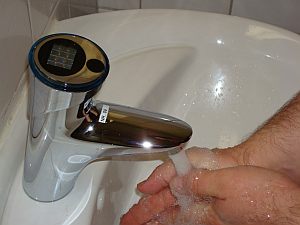
How can energy consumption be reduced reasonably? This question is studied by the wbk Institute of Production Science under its powerfluid project. The engineers developed a method to reduce total energy consumption of electronically controlled taps. The energy is produced directly by the water used.
So far, electronically controlled taps have always been bound to external energy sources, such as an electricity grid or a battery. So-called fluidic systems based on water or gas, however, release the energy stored inside into the environment unused. With powerFLUID this energy is taken and converted into electricity. It is then used to operate the automatic tap.
To produce the energy required, the engineers from the wbk Institute of Production Science have developed a conversion system. It consists of a microturbine. Magnets are attached to its blades. These magnets generate a magnetic field by rotation. It is converted into electricity by means of a generator.
One prototype tap developed under the project is now used in practice. “If it was produced in series, powerFLUID would enormously reduce energy consumption and, hence, costs”, explains wbk engineer Stefan Herder. It can also be applied in other fields, as is pointed out by his colleague Martin Weis. “The principle developed by wbk is suited for many systems running on fluids”.
Energy harvesting, i.e. the conversion and use of existing, but so far unused energy, is in the focus of wbk. Apart from water, use of another type of energy is considered under the powerFLUID project: Light. Via a solar cell, a sensor controlling the start and stop of water supply by the tap is provided with energy.
In close partnership with society, KIT develops solutions for urgent challenges – from climate change, energy transition and sustainable use of natural resources to artificial intelligence, sovereignty and an aging population. As The University in the Helmholtz Association, KIT unites scientific excellence from insight to application-driven research under one roof – and is thus in a unique position to drive this transformation. As a University of Excellence, KIT offers its more than 10,000 employees and 22,800 students outstanding opportunities to shape a sustainable and resilient future. KIT – Science for Impact.