
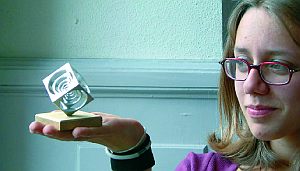
To complete the scientifically accompanied pilot phase of the Hector Seminar of eight years duration in Northern Baden, a congress will take place on March 4 on KIT Campus South. The Hector Seminar is an initiative to support highly talented pupils in the fields of mathematics, information science, natural sciences, and engineering. KIT has been cooperating with this initiative for several years now. The congress will start at 9 o’clock at the Kollegiengebäude am Ehrenhof (Englerstrasse 11, building 11.40). It is planned to end at 16 hrs.
Dr. Hans Werner Hector, co-founder of the SAP enterprise, and his wife Josephine initiated the Hector Seminar. Interdisciplinary thinking, methodology, and research of the participants as well as their interest in mathematics, information science, natural sciences, and engineering shall be enhanced. So far, the Hector Seminar has concentrated on the conurbations of Karlsruhe, Heidelberg, and Mannheim in Baden-Württemberg.
The congress will focus on the results obtained by Professor Dr. Kurt Heller and his team from the LMU Munich. They accompanied the pilot phase on a scientific level. Apart from presentations, the program also includes an extensive poster exhibition of best-practice examples of present participants in the Hector Seminar. The congress visitors will have the opportunity to inform themselves in detail about the practical work of the Hector Seminar and to exchange experience with the course directors and pupils. From 14 to 15.30 hrs, visitors are invited to take part in a podium discussion with representatives of science and education policy as well as with course directors.
In October 2009, the Hector Seminar marked the start of the fourth round of KIT’s cooperation with science institutions in the region. Every year, young talents gather experience in scientific work in small groups for six months. In 2009/2010, pupils analyze genetic fingerprints at the Center for Advanced Technological and Environmental Training, they focus on magic at the Mathematical Laboratory, they design an experimental setup at the Physics Laboratory, and study technical facilities at the Institute for Production Technology.
In close partnership with society, KIT develops solutions for urgent challenges – from climate change, energy transition and sustainable use of natural resources to artificial intelligence, sovereignty and an aging population. As The University in the Helmholtz Association, KIT unites scientific excellence from insight to application-driven research under one roof – and is thus in a unique position to drive this transformation. As a University of Excellence, KIT offers its more than 10,000 employees and 22,800 students outstanding opportunities to shape a sustainable and resilient future. KIT – Science for Impact.