
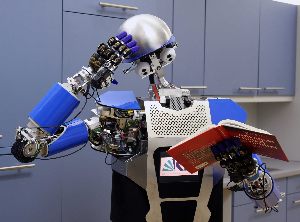
In the new Anthropomatics and Robotics Focus, more than 250 scientists from various disciplines will work on the vision of establishing intelligent and human-centered systems in our everyday life. On Tuesday, November 30, the Focus will be opened officially. Journalists are cordially invited to attend a press conference with the professors involved and to participate in a guided tour of the laboratory from 13.30 to 15.00 hrs at the Fraunhofer-Institut für Optronik, Systemtechnik und Bildauswertung (IOSB, Fraunhofer Institute for Optronics, Systems Technology, and Image Evaluation), Karlsruhe, Fraunhoferstraße 1.
The term “anthropomatics“ was coined by informatics professors in Karlsruhe about 10 years ago and refers to the science of the relationship between humans and machines. It is aimed at making machines capable of communicating, interacting, and acting autonomously like a human being. A number of application scenarios result for anthropomatic systems, some of which have already been implemented at KIT: Driver assistance systems help the driver in road traffic, friends communicate in different languages thanks to a mobile language translator, and robots help in households. While robots have been used nearly exclusively in industrial environments so far, the new, intelligent, and learning systems will enter a completely new market in the everyday surroundings of humans. “In the field of humanoid robotics, service and medical robotics, but also in industry robotics, intuitive and largely natural interaction between humans and machines is gaining importance and a prerequisite for the use of machines in our everyday life,” explains Professor Heinz Wörn, Dean of the Department of Informatics.
Development of human-centered systems requires basic understanding of the human being, its anatomy, motor function, perception, information processing, and behavior. “Our life is increasingly influenced by machines. This will give rise to new problems, which can only be solved by informatics in cooperation with the humanities. For this reason, the Department of Humanities and Social Sciences has joined the Departments of Informatics, Mechanical Engineering, and Electrical Engineering to establish an interdisciplinary approach,” says Professor Rüdiger Dillmann, Spokesman of the new KIT Focus.
Main topics of the KIT Anthropomatics and Robotics Focus are the interaction and communication of humans with technical systems, humanoid robotics, and machine intelligence. Understanding of language and images, perception of situations, generation of experience, and biosignal and sensor data processing in sensor networks are in the center of attention. In addition, the Focus covers the design, setup, and automation of robots for various application scenarios in medicine, industry, or in the service sector.
The inauguration ceremony will take place at Fraunhofer IOSB, Fraunhoferstr. 1, Karlsruhe.
Program
10:00 hrs Welcome Addresses
Prof. Dr. Horst Hippler
President of KIT
Norbert Käthler
Representative of the City of Karlsruhe
Henrik Schunk
Associate Director, SCHUNK GmbH
Prof. Dr.-Ing. Heinz Wörn
Dean of the Department of Informatics
Prof. Dr. Alexander Wanner
Dean of Studies and Examinations of the Department of Mechanical Engineering
Prof. Dr. phil. Klaus Bös
Dean of the Department of Humanities and Social Sciences
10:40 hrs Presentation of the KIT Anthropomatics and Robotics Focus
Prof. Dr.-Ing. Rüdiger Dillmann
KIT, Institute of Anthropomatics, Spokesman
11:10 hrs Coffee Break
11:30 hrs Invited Talk
Prof. Dr. Stefan Schaal, University of Southern California
12:00 hrs Invited Talk
Dr. Ralf Koeppe, KUKA Roboter GmbH
12:30 hrs Invited Talk
Prof. Dr.-Ing. Edgar Körner, Honda Research Institute Europe GmbH
13:00 hrs Lunch
13:30 hrs Press Conference (Max Syrbe-Saal)
14:00 hrs Lab Tour
In close partnership with society, KIT develops solutions for urgent challenges – from climate change, energy transition and sustainable use of natural resources to artificial intelligence, sovereignty and an aging population. As The University in the Helmholtz Association, KIT unites scientific excellence from insight to application-driven research under one roof – and is thus in a unique position to drive this transformation. As a University of Excellence, KIT offers its more than 10,000 employees and 22,800 students outstanding opportunities to shape a sustainable and resilient future. KIT – Science for Impact.