
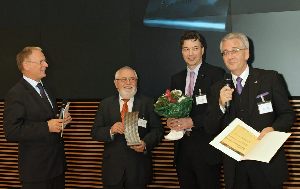
With its environmentally compatible and energy-efficient cement Celitement®, Karlsruhe Institute of Technology (KIT) is one of the winners of the German Material Efficiency Award of the Federal Ministry of Economics and Technology (BMWi). Compared to conventional cement production processes, this KIT development promises enormous savings of energy and a much more favorable emission balance. Today, State Secretary Jochen Homann handed over the awards to four medium-sized enterprises and one research institution for their innovative ideas and processes. KIT was granted the award for its application-oriented research to improve material efficiency.
State Secretary Jochen Homann handed over the award today at the conference “Mit Ressourceneffizienz auf der Siegerstraße – Praxis und Forschung zeigen den Weg” (with resource efficiency on the path to victory – practice and research show the way), Berlin. For KIT, the Vice President for Research and Innovation, Dr. Peter Fritz, and Dr. Peter Stemmermann, one of the four inventors of Celitement®, accepted the award which is remunerated with EUR 10,000. “The Material Efficiency Award demonstrates we are right on track with Celitement® and what a pioneering innovation it is for the so far highly energy-consuming process of cement production,” said Dr. Peter Fritz.
Today Ordinary Portland Cement is the industry product that is applied in highest quantity worldwide. Its production and processing require enormous resources of limestone and gypsum. “For the production of Celitement®, we will only need about one third of the limestone quantity and we can do completely without gypsum,” outlines scientist Dr. Peter Stemmermann.
Compared to conventional cement, Celitement® production presumably will require half of the energy and half of the carbon dioxide emissions. Meanwhile, the Celitement® GmbH, a spin-off of the four inventors, KIT, and the industry partner SCHWENK Zement KG, has been founded for the further development of the product.
“Celitement® has the potential of replacing conventional cement in major applications in the long term,” underlines Dr. Hanns-Günther Mayer, one of the directors of Celitement® GmbH. So far, the KIT scientists have produced Celitement® on the laboratory scale. After more than one year of extensive and very successful tests, the Celitement GmbH is presently building a pilot plant with an investment volume of EUR 5 million on KIT Campus North. From spring 2011, it will produce 100 kg of Celitement® daily. “This will be the next step on the way towards the maturity of this environmentally compatible cement,” says Mayer.
With its annual German Material Efficiency Award, the Federal Ministry of Economics and Technology wishes to support the economically and ecologically positive effects of material efficiency. Five technically convincing products, processes, or services are granted EUR 10,000 each.
Further information on the award ceremony can be found under: http://www.bmwi.de/BMWi/Navigation/Presse/pressemitteilungen.html .
Karlsruhe Institute of Technology (KIT) is one of Europe’s leading energy research establishments. The KIT Energy Center pools fundamental research with applied research into all relevant energy sources for industry, households, services, and mobility. Holistic assessment of the energy cycle also covers conversion processes and energy efficiency. The KIT Energy Center links excellent competences in engineering and science with know-how in economics, the humanities, and social science as well as law. The activities of the KIT Energy Center are organized in seven topics: Energy conversion, renewable energies, energy storage and distribution, efficient energy use, fusion technology, nuclear power and safety, and energy systems analysis.
In close partnership with society, KIT develops solutions for urgent challenges – from climate change, energy transition and sustainable use of natural resources to artificial intelligence, sovereignty and an aging population. As The University in the Helmholtz Association, KIT unites scientific excellence from insight to application-driven research under one roof – and is thus in a unique position to drive this transformation. As a University of Excellence, KIT offers its more than 10,000 employees and 22,800 students outstanding opportunities to shape a sustainable and resilient future. KIT – Science for Impact.