
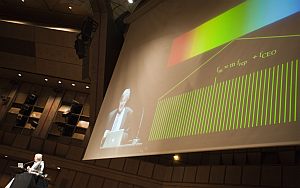
In the 2010/11 winter semester, an ambitious teaching project of nine universities and research institutions started in the southern area of the national “Competence Consortium Elec-trochemistry”. Every two years, the institutions involved will organize lectures and seminars that will be transmitted live by video to the other locations. In this semester, KIT and the Justus Liebig University of Gießen (JLU) will start.
Several scientists of KIT will present a lecture on “Characterization Methods and Modeling in Battery Research”. Professor Jürgen Janek from the JLU will give a lecture about “Applied Electrochemis-try – Basis of Advanced Physico-Chemical Technologies”. A video conference system installed at all locations involved is used to net-work students and the scientific staff at the lecture halls and seminar rooms in a digital auditorium that can communicate with the respective lecturer with hardly any barriers during his lecture.
Establishment of the Competence Consortium Electrochemistry is funded by the Federal Ministry of Education and Research (BMBF) with about EUR 35 million from 2009 to 2011. Of this amount, EUR 21.8 million will be spent in the southern area. The following institu-tions are members of the alliance in the southern area:
• Technical University of Darmstadt
• Institute for Solid State and Materials Research Dresden (IFW)
• Technical University of Freiberg
• Justus Liebig University of Gießen (JLU)
• Karlsruhe Institute of Technology (KIT)
• Max Planck Institute for Solid State Research Stuttgart
• German Aerospace Center Stuttgart (DLR)
• Center for Solar Energy and Hydrogen Research Ulm (ZSW)
• University of Ulm
The southern area of the consortium is coordinated by Professor Horst Hahn, Director of the KIT Institute of Nanotechnology. The spokesman is Professor Werner Tillmetz (ZSW Ulm). The education and training program is coordinated by Professor Bernd Smarsly and Professor Jürgen Janek (both JLU). Professor Karsten Albe (Technical University of Darmstadt) is responsible for the technical management of the project.
In close partnership with society, KIT develops solutions for urgent challenges – from climate change, energy transition and sustainable use of natural resources to artificial intelligence, sovereignty and an aging population. As The University in the Helmholtz Association, KIT unites scientific excellence from insight to application-driven research under one roof – and is thus in a unique position to drive this transformation. As a University of Excellence, KIT offers its more than 10,000 employees and 22,800 students outstanding opportunities to shape a sustainable and resilient future. KIT – Science for Impact.