
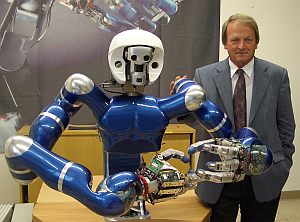
Mechatronics combines mechanics, electronic engineering, computing, and information technology into intelligent overall systems. Presenting examples of innovative developments, Professor Gerd Hirzinger expounds the significance and importance of this interdisciplinary technology. The head of the Institute of Robotics and Mechatronics at the German Aerospace Center (Deutsches Zentrum für Luft- und Raumfahrt - DLR) at Oberpfaffenhofen will read the2010 Ernst Blickle Lecture
on “Robotics and Mechatronics - From Space Through to Production, Mobility, and Surgery of the Future”
on Friday, June 18, 17 hrs,
at the KIT Tulla-Hörsaal
(Campus South, Englerstraße 11, building No. 11.40).
The opening address will be given by Professor Fritz Klocke of the Laboratory for Machine Tools and Production Engineering at the RWTH Aachen University who is member of the Board of Trustees of the SEW-EURODRIVE Foundation.
The Ernst Blickle Lectures are organized every two years by KIT and the SEW-EURODRIVE Foundation to promote the exchange between science, industry, politics, and society. The Ernst Blickle Prize, which is awarded by the foundation on the occasion of these lectures, aims to honor exceptional achievements in these fields. Professor Gerd Hirzinger was awarded the Ernst Blickle Prize in 2009 for outstanding research and applied work in mechatronics and robotics. The lecture will be followed by the awarding of SEW- EURODRIVE studies prizes to 18 graduates from the fields of engineering, electrical engineering, and economics from eight universities.
The SEW-EURODRIVE Foundation established in 1989 supports the acquisition, deepening and further development of scientific findings in engineering and economy. SEW-EURODRIVE is one of the internationally leading companies in driving technology and automation with more than 13,000 employees worldwide.
In close partnership with society, KIT develops solutions for urgent challenges – from climate change, energy transition and sustainable use of natural resources to artificial intelligence, sovereignty and an aging population. As The University in the Helmholtz Association, KIT unites scientific excellence from insight to application-driven research under one roof – and is thus in a unique position to drive this transformation. As a University of Excellence, KIT offers its more than 10,000 employees and 22,800 students outstanding opportunities to shape a sustainable and resilient future. KIT – Science for Impact.