
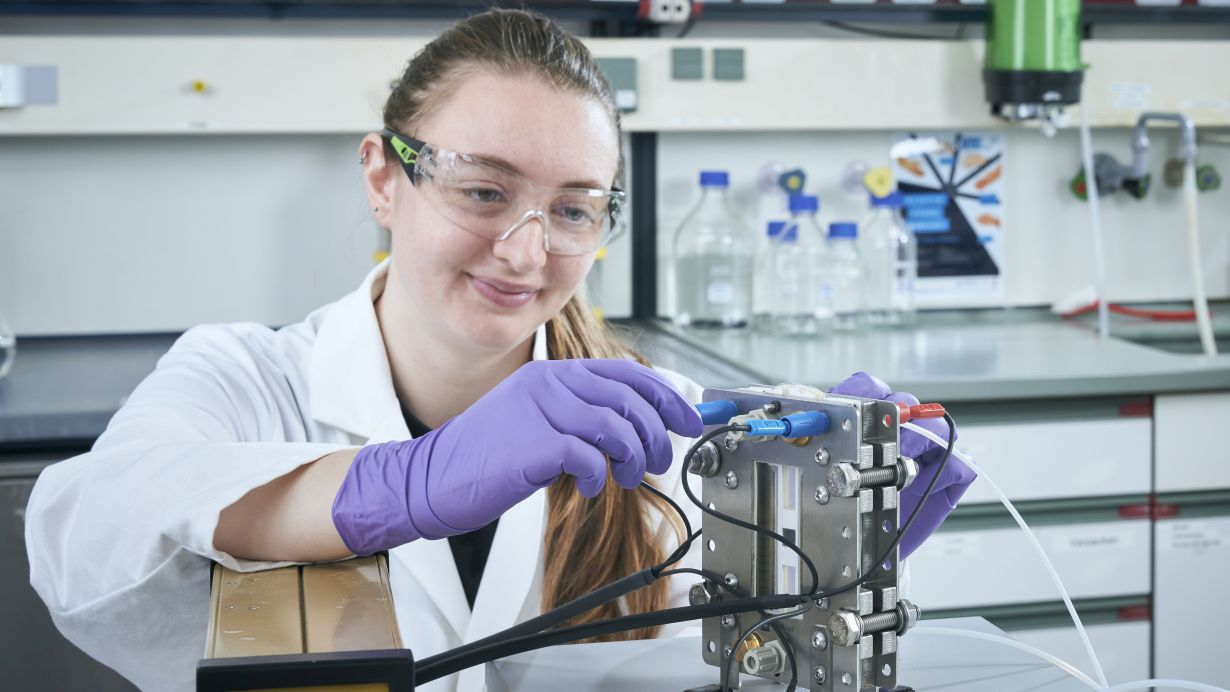
Fine chemicals are part of daily life, serving as dyes, fragrances, and food additives. However, their production harms the climate and environment due to toxic chemical precursors. Since 2023, researchers in the ETOS Future Cluster, jointly led by the Karlsruhe Institute of Technology (KIT), have been working to replace conventional production processes with electrochemical processes that use renewable electricity. Following a successful initial phase, Germany’s Federal Ministry of Research, Technology, and Space (BMFTR) funds the cluster for an additional three years, providing EUR 12 million.
During the initial funding period, the ETOS (Electrifying Technical Organic Syntheses) future cluster focused on investigating chemical processes and developing engineering methods to improve electroorganic synthesis. For the second funding period from April 1, 2026, to March 31, 2029, the researchers and the participating companies will shift their focus to process engineering, piloting newly developed methods with industrial partners, and synthesizing considerably more chemicals.
Electroorganic Synthesis: Especially Sustainable
In electroorganic synthesis, organic compounds are produced or converted using electrolysis. "It's an especially sustainable process because electricity directly drives the chemical reaction, and the reaction requires much smaller amounts of less aggressive chemicals," said Ulrike Krewer, head of the Institute for Applied Materials — Electrochemical Technologies (IAM-ET) at KIT and co-spokesperson for ETOS. "This makes it possible to completely avoid or drastically reduce waste from chemical processes. And the electricity used in the process can come from renewable sources.” New approaches and innovative electrode materials enable the development of efficient electroorganic synthesis processes that researchers had previously considered impractical. These innovations offer new prospects for decarbonizing chemical production processes.
During the first funding phase, ETOS participants worked with other partners in academia and industry not only to develop new methods but also published more than 20 papers on electroorganic synthesis, filed 8 patents, and brought 2 products to market.
KIT Contributes Engineering Perspective
The KIT team, headed by Krewer, provides the engineering perspective for the cluster. “Now, we’re systematically expanding ETOS at the process level. We want to find the most efficient and sustainable ways to operate electrolyzers and automate production, and to make it more economical,” Krewer said. In addition to the IAM-ET, other KIT institutes involved in the new funding period are the Institute of Catalysis Research and Technology, the Institute for Technology Assessment and Systems Analysis, the Institute for Control Systems, the Institute for Micro Process Engineering, and the Institute for Biological and Chemical Systems. Professor Siegfried Waldvogel of the Max Planck Institute for Chemical Energy Conversion in Mülheim an der Ruhr will continue as the ETOS scientific lead. The optimization of electrosynthesis reactions using modern algorithms is his main focus of ETOS.
About ETOS
ETOS is one of the Clusters4Future initiatives funded by the BMFTR. Along the Rhine, from Freiburg to the Ruhr region, the ETOS future cluster bundles the expertise of partners in the field of electroorganic synthesis of chemicals. Participating institutions include the University of Kaiserslautern-Landau, Ruhr University Bochum, Johannes Gutenberg University Mainz, the Fraunhofer Institute for Microengineering and Microsystems, as well as industrial partners such as BASF, Boehringer Ingelheim, Evonik, and ABB. The BMFTR is providing EUR 12.1 million for the second funding period. Industrial partners are contributing an additional EUR 6 million.
More about the ETOS Future Cluster
More about the Institute for Applied Materials – Electrochemical Technologies