
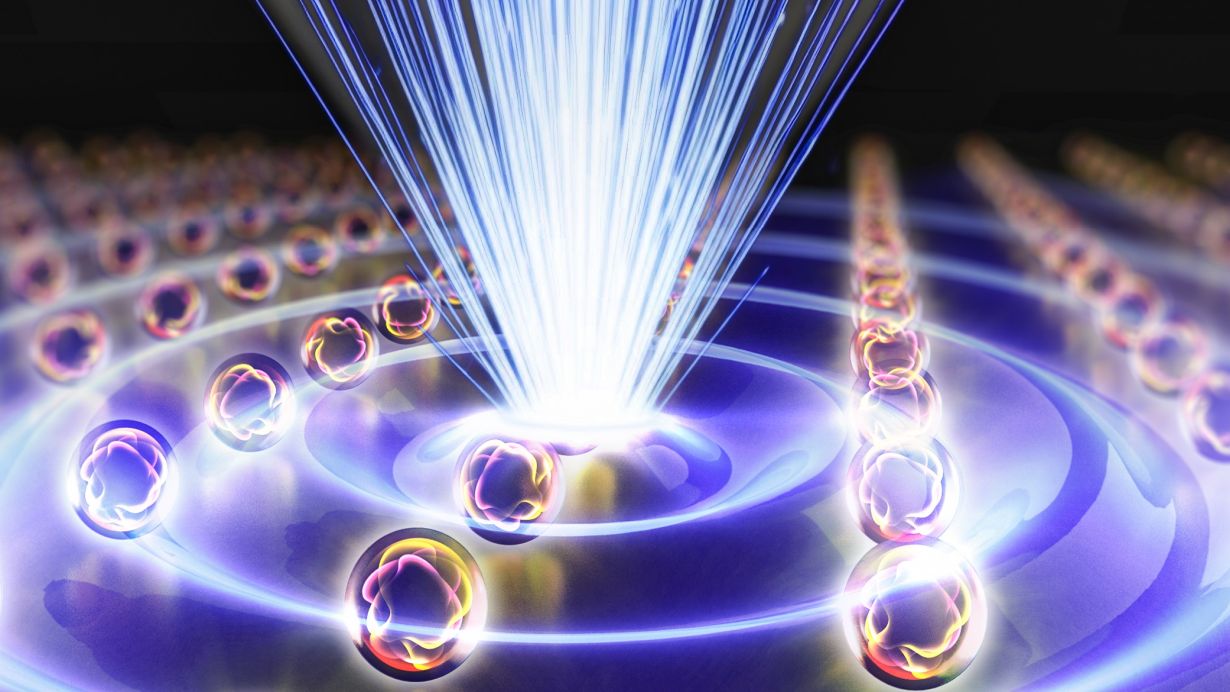
Photonic space-time crystals are materials that could increase the performance and efficiency of wireless communication or laser technologies. They feature a periodic arrangement of special materials in three dimensions as well as in time, which enables precise control of the properties of light. Working with partners from Aalto University, the University of Eastern Finland and Harbin Engineering University in China, scientists from the Karlsruhe Institute of Technology (KIT) have shown how such four-dimensional materials can be used in practical applications. They published their results in Nature Photonics (DOI: 10.1038/s41566-024-01563-3).
Photonic time crystals consist of materials with uniform composition in space but properties that vary periodically over time. With this periodic variation, the spectral composition of light can be modulated and amplified as needed – key capabilities for optical information processing. “This gives us new degrees of freedom but also poses a lot of challenges,” said Professor Carsten Rockstuhl from KIT’s Institute for Theoretical Solid-State Physics and Institute of Nanotechnology. “This study paves the way for using these materials in information processing systems capable of using and amplifying light of any frequency.”
A Step Closer to Four-dimensional Photonic Crystals
The key parameter of a photonic time crystal is its bandgap in momentum space. Momentum is a measure of the direction in which light propagates. A bandgap specifies the direction in which light has to propagate in order to be amplified; the wider the bandgap, the greater the amplification. “Previously we’ve had to intensify the periodic variation of material properties such as the refractive index to achieve a wide bandgap. Only then can light be amplified at all,” explained Puneet Garg, one of the study’s two lead authors. “Since the options for doing that are limited for most materials, it’s a big challenge.”
The researchers’ solution involved combining photonic time crystals with an additional spatial structure. They created “photonic space-time crystals” by integrating photonic time crystals made of silicon spheres that “trap” and hold light longer than had previously been possible. The light then reacts much better to periodic changes in material properties. “We’re talking about resonances that intensify the interactions between light and matter,” said Xuchen Wang, the other lead author. “In such optimally tuned systems, the bandgap extends across nearly the entire momentum space, which means light can be amplified regardless of its direction of propagation. This could be the crucial missing step on the way toward practical use of such novel optical materials.”
“We’re very excited about this breakthrough in photonic materials, and we look forward to seeing the long-term impact of our research. Now the enormous potential of modern optical materials research can be realized,” Rockstuhl said. “The idea isn’t limited to optics and photonics; it can be applied to various physical systems and has the potential to inspire new research in other fields.”
This research project was carried out in the “Wave phenomena: analysis and numerics” Collaborative Research Center, funded by the German Research Foundation (DFG), and is embedded in the Helmholtz Association’s Information research field.
Original publication
X. Wang, P. Garg, M. S. Mirmoosa, A. G. Lamprianidis, C. Rockstuhl and V. S. Asadchy: Expanding momentum bandgaps in photonic time crystals through resonances. Nature Photonics, 2024. DOI: 10.1038/s41566-024-01563-3
“Wave phenomena: analysis and numerics” Collaborative Research Center