
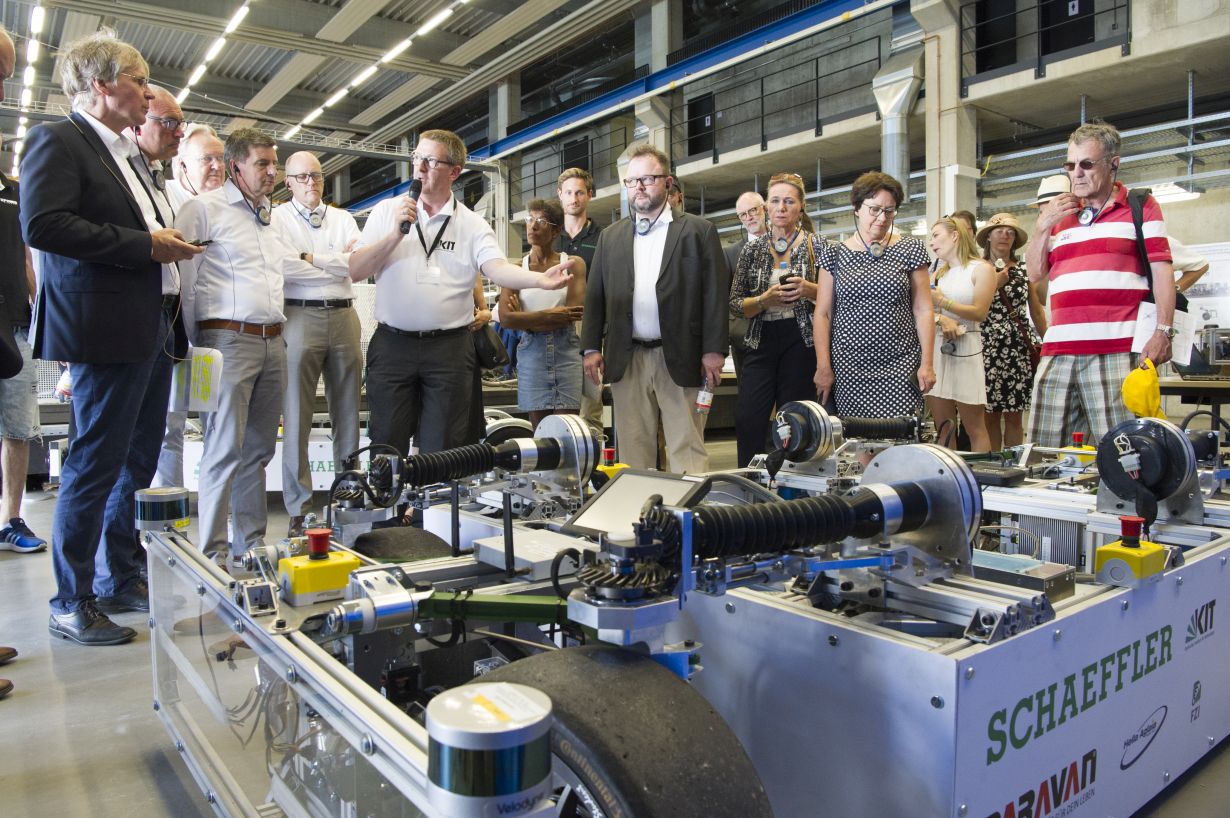
Self-learning tractors, synthetic CO2-neutral fuels, new technologies for e-mobility, and innovative vehicle and traffic systems. Add to that a knowledge rally for children and a first-rate stage program. All this was part of the Open Day at Karlsruhe Institute of Technology (KIT) on Saturday, June 29, 2019 which also marked the beginning of this year’s EFFEKTE science festival in Karlsruhe. 9,000 visitors delved into the exciting world of science on Campus East in interactive activities, lectures and demonstrations.
You can download photos from the Open Day at
http://fotoweb.aserv.kit.edu/fotoweb/albums/XRd4JLfvRaxCPiqutaS3ZH-BLYsAMC1tKNVzhQ/
“I’m very happy about how much interest the people from and around Karlsruhe have shown, coming to our open day despite the soaring temperatures. Days like these also offer wonderful opportunities for us to present our research and have some interesting discussions with many local people,” says the President of KIT, Professor Holger Hanselka.
“To achieve this, the KIT employees and students set up an extremely varied and exciting program with their interactive activities, demonstrations and exhibits. I’m very proud that we were able to convey the exciting world of our research so well.”
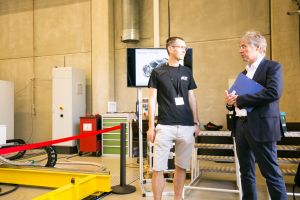
The focus of this year's event was the broad subject of mobility with numerous vehicle-related technical facilities such as test stations and research halls on KIT Campus East which is located in the vicinity of the Baden-Württemberg Test Center for Autonomous Driving. Among other things, there were demonstrations on the state-of-the-art test stations for rail sensors and machinery as well as on a chassis dynamometer. The students of the KA-RaceIng team demonstrated their racing cars, and at the booth of the Kamaro university group there were self-driving model robots for use in agriculture on show, pulling in the crowds, as did the presentation of renewable fuels from the reFuels research project.
But the scientists of KIT also showcased exciting current projects far beyond the issue of mobility, ranging from robot technologies and new materials to the Energy Lab 2.0. There was also lots on offer for children including the traditional knowledge rally and numerous interactive experiments.
The different activities of the student groups and many other KIT institutions as well as their partners and sponsors also offered plenty of variety and information. In the buildings and the info tents on Campus East, KIT presented itself as an attractive place of study and employment.
In the afternoon, President Professor Holger Hanselka officially kicked off the EFFEKTE science festival together with Karlsruhe mayor Dr. Frank Mentrup, where numerous Karlsruhe research institutions are presenting hands-on science. “In Karlsruhe, KI not only stands for ‘Künstliche Intelligenz’ (Artificial Intelligence). Because the fan-shaped city of Karlsruhe has much more to offer in science, as the Open Day at KIT impressively showed. So KI also stands for ‘Karlsruhe Innovations’. The EFFEKTE science festival taking place the next nine days is therefore all about scientific innovations from the fan-shaped city,” says mayor Mentrup.
Colorful stage program
Variety is also the theme on the stage, with the shows of Austrian science cabaret artists Science Busters and TV stand-up comedian Bernhard Hoëcker continuing into the evening after the opening of the festival.
Karlsruhe Unifest 2019
Alongside the Open Day, Unifest organized by KIT students will run on Campus South. On several stages around the Altes Stadion, live bands and DJs will be serving up a fantastic party atmosphere.
You can download photos from the Open Day at
http://fotoweb.aserv.kit.edu/fotoweb/albums/XRd4JLfvRaxCPiqutaS3ZH-BLYsAMC1tKNVzhQ/
The photos may be used exclusively in the context given above.
In close partnership with society, KIT develops solutions for urgent challenges – from climate change, energy transition and sustainable use of natural resources to artificial intelligence, sovereignty and an aging population. As The University in the Helmholtz Association, KIT unites scientific excellence from insight to application-driven research under one roof – and is thus in a unique position to drive this transformation. As a University of Excellence, KIT offers its more than 10,000 employees and 22,800 students outstanding opportunities to shape a sustainable and resilient future. KIT – Science for Impact.