
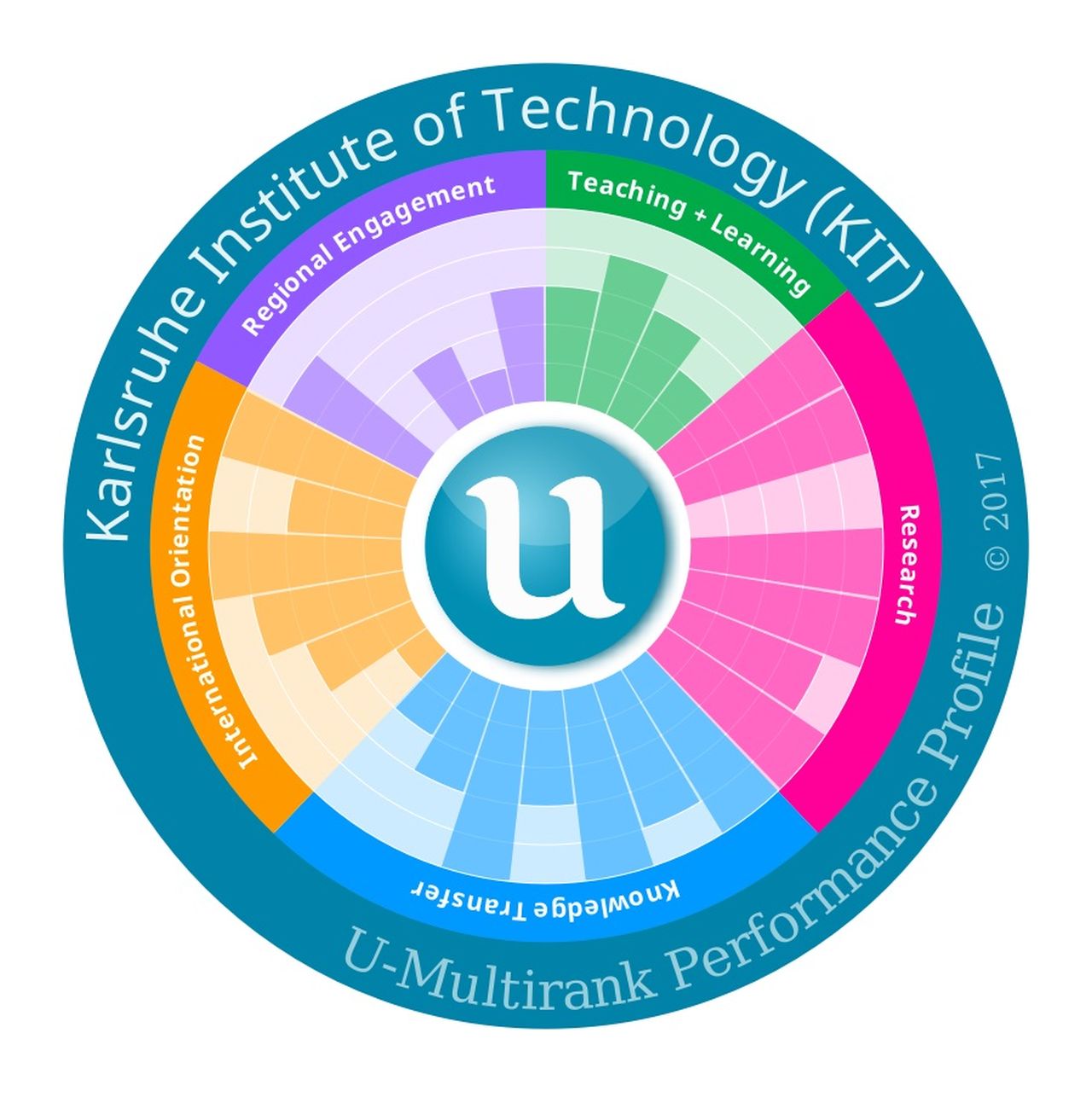
In the category of research, Karlsruhe Institute of Technology (KIT) is ranked in the top group for a number of indicators by the “EU-Multirank” ranking scheme funded by the EU Commission. Among these indicators are the number of scientific publications, third-party funds acquired, and the number of post-docs. In the category of knowledge transfer, KIT is given excellent marks for patents and startups among others.
Individual subjects also reach very good results for a number of indicators. KIT’s electrical engineering and information technology reaches the top group for seven, KIT’s informatics for six, and mechanical engineering for five indicators. Informatics is rated excellently in the category of research, including publications and the number of doctorates. As regards knowledge transfer, KIT’s electrical engineering and information technology as well as chemical engineering reach good results, among others for co-publications with industrial partners.
KIT also reaches top results in international affairs as regards the number of employees from abroad and the number of publications made together with partners from abroad. KIT’s international orientation of education is considered excellent in electrical engineering and information technology in particular. In a survey, the students of KIT rated the learning experience to be good in all subjects. Regarding the graduation rate and studies duration, private and small universities with a comparatively small number of students and restricted admission in most subjects were found to have advantages. Here, none of the big German universities reaches the top group.
U-Multirank wishes to cover the variety of universities worldwide by a variety of criteria. On the web portal, interested persons can compare universities according to their own criteria. The underlying data were partly supplied by the universities and partly taken from surveys of students and searches in publication and patent databases.
More information is given at www.umultirank.org
In close partnership with society, KIT develops solutions for urgent challenges – from climate change, energy transition and sustainable use of natural resources to artificial intelligence, sovereignty and an aging population. As The University in the Helmholtz Association, KIT unites scientific excellence from insight to application-driven research under one roof – and is thus in a unique position to drive this transformation. As a University of Excellence, KIT offers its more than 10,000 employees and 22,800 students outstanding opportunities to shape a sustainable and resilient future. KIT – Science for Impact.