
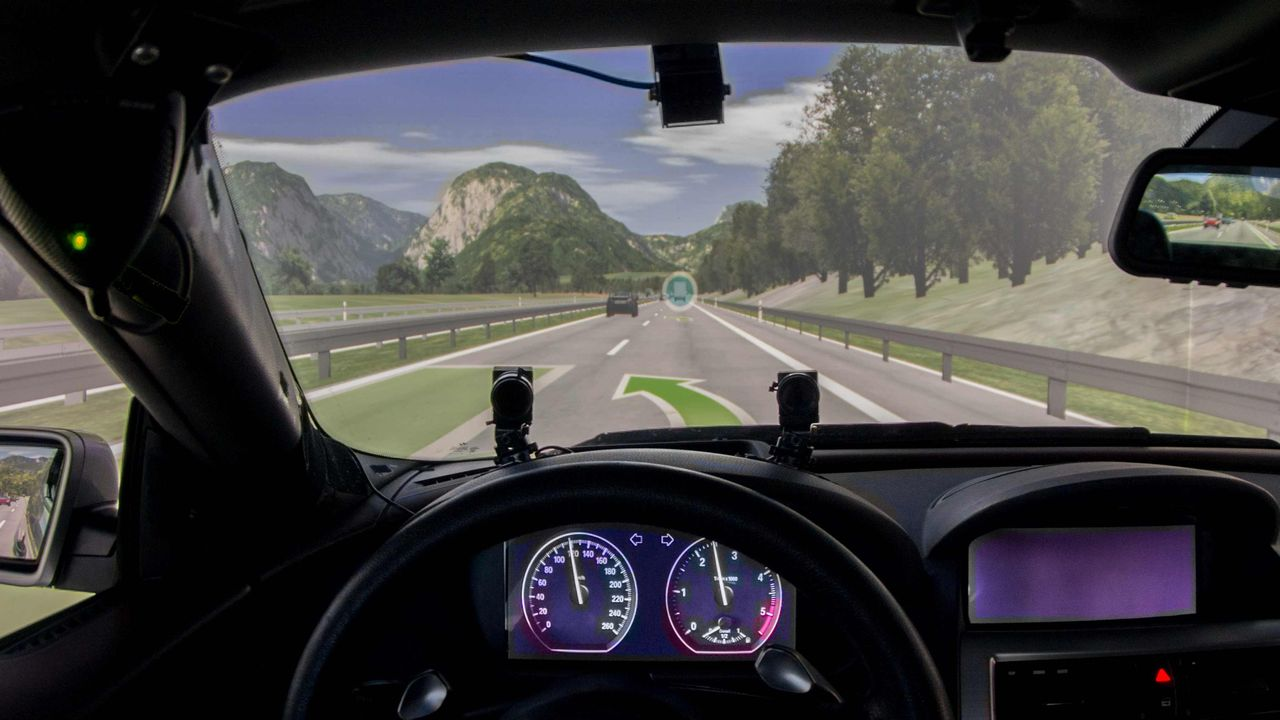
Autonomous driving may enhance safety of road traffic, provided that vehicles and drivers interact without problems. The interdisciplinary research alliance “Personalisierte, adaptive kooperative Systeme für automatisierte Fahrzeuge” (PAKoS, Personalized, Adaptive Cooperative Systems for Automated Vehicles) coordinated by Karlsruhe Institute of Technology (KIT) is aimed at developing and implementing an assistance system for increased safety. In the next three years, the project will be funded by the Federal Ministry of Education and Research (BMBF) with about EUR 3 million.
“We want to contribute our vast expertise obtained by research at the interface of information technology, mobility, and man,” Sören Hohmann, Head of the KIT Institute for Control Systems, says. It is the objective of PAKoS to implement for the first time ever individualized and personalized cooperation between car and user. The new system is to acquire the capabilities and current state of the driver, to adapt automatically, and to safely transfer vehicle control to the driver on this basis. Later on, it is to take over control again, when e.g. leaving the motorway or driving through construction sites.
To assess the situation, the assistance system is to use images recorded in the vehicle interior and to provide information in real time on the current state of the driver. Among others, the system is to recognize whether the driver is tired or alert and whether he/she has his/her hands on the steering wheel. In addition, a portable profile of the driver is to provide information on the typical driving behavior of the user. In either case, data sovereignty remains with the user.
Another challenge will consist in the development of interaction interfaces for reliable multi-modal communication between vehicle and user via visualization, haptics, and audio systems. “Our interdisciplinary research will bridge the gap between autonomous and manual driving and ensure safe vehicle control shared by man and machine,” Dr. Michael Flad, scientist of KIT and coordinator of PAKoS, adds.
The components developed in partial projects are planned to be integrated into a prototype that will be evaluated in a user study. Apart from KIT and the FZI Research Center for Information Technology, the “PAKoS” project partners are the Technical University of Munich, the Fraunhofer Institute of Optronics, System Technologies, and Image Exploitation, Robert Bosch GmbH, BMW AG, Spiegel Institut Mannheim GmbH & Co. KG, Videmo Intelligent Video Analysis GmbH & Co. KG, mVISE AG, b.i.g.-Group and Stadtmobil Car Sharing. The project budget totals approx. EUR 4.1 million, with 76% being funded by the BMBF. The project will expire in late 2019.
More about the KIT Mobility Systems Center http://www.kit.edu/research/6720.php
In close partnership with society, KIT develops solutions for urgent challenges – from climate change, energy transition and sustainable use of natural resources to artificial intelligence, sovereignty and an aging population. As The University in the Helmholtz Association, KIT unites scientific excellence from insight to application-driven research under one roof – and is thus in a unique position to drive this transformation. As a University of Excellence, KIT offers its more than 10,000 employees and 22,800 students outstanding opportunities to shape a sustainable and resilient future. KIT – Science for Impact.